

Hips get tight after 50 for four main reasons. You sit more. Your muscles and connective tissue lose some stretch. Your glutes and core get weaker. And old injuries change how you move. The fix is not hard stretching. Do gentle hip flexor stretches, glute bridges, and slow hip rotations for 10 minutes a day. Add strength work. Get hands-on help if you stay stuck.
You stand up from a chair. Your hips don’t want to come along.
Sound familiar? You’re not imagining it. I turned 60 not long ago, and I sit far more than I used to. My hips noticed right away. Yikes.
Maybe your stride feels short. Maybe your lower back aches after a walk or a round of golf. Maybe the car seat has become a negotiation.
Here’s the good news. Your body isn’t broken. Plenty of adults feel older than their age, and most of the time the cause is lost movement, not lost youth. Let me show you why hips tighten and what actually helps.
Why Your Hips Stiffen Up After 50
Four things drive most hip stiffness in older adults. Most of us have a mix.
Too much sitting
Driving. Streaming shows. Desk work. Add it up and you sit for hours without noticing. I can sit for over an hour and never move once.
Sitting keeps your hip flexors short and slows blood flow to the area. Over time, the tightness stops feeling temporary. It feels like your new normal. Our post on the signs that sitting is hurting your mobility shows how fast this builds. And if you get an ache after sitting, read about a painful hip after sitting.
Muscles and connective tissue lose some stretch
With age, muscles and the fascia around them get less elastic. Fascia is the thin web of tissue that wraps your muscles. It adapts slowly. That means you need steady, gentle input, not one heroic week of stretching.
Genes play a part too. Some people are naturally more flexible than others, so skip the comparison with your gym buddy.
Weak glutes and a quiet core
When your glutes don’t pull their weight, your hips and lower back pick up the slack. You may notice:
- Hip tightness
- Low back aches
- A shorter stride
- Trouble getting up off the floor
You lose muscle as you age unless you train it. That’s just how it works. If you’ve never lifted anything heavier than a grocery bag, start with our guide on how seniors can start strength training safely.
Old injuries that never fully healed
A cranky knee. An ankle you rolled years ago. A back that “went out” once. Your body works around each one, and the workaround becomes your normal. Your walking pattern can reveal hidden imbalances from those old hurts.
Signs Your Hips Are the Problem
| What you notice | What may be behind it |
| Trouble crossing your legs | Limited hip rotation |
| Stiff getting out of the car | Tight hip flexors |
| Aching lower back | Hips not moving, back covering for them |
| Feeling “locked up” in the morning | Stiffness after hours of rest |
| A shorter golf swing | Less hip turn |
Golfers, take note. Hip turn drives your swing, and these hip and shoulder stretches can help.
Many people shrug this off as “just aging.” It isn’t. It’s reduced mobility, and mobility can improve. If your hips also click or pop, find out why hips crack when you move.
One honest note. Sharp pain, swelling, or groin pain is not a stretching problem. See your doctor, because arthritis can also stiffen hips.
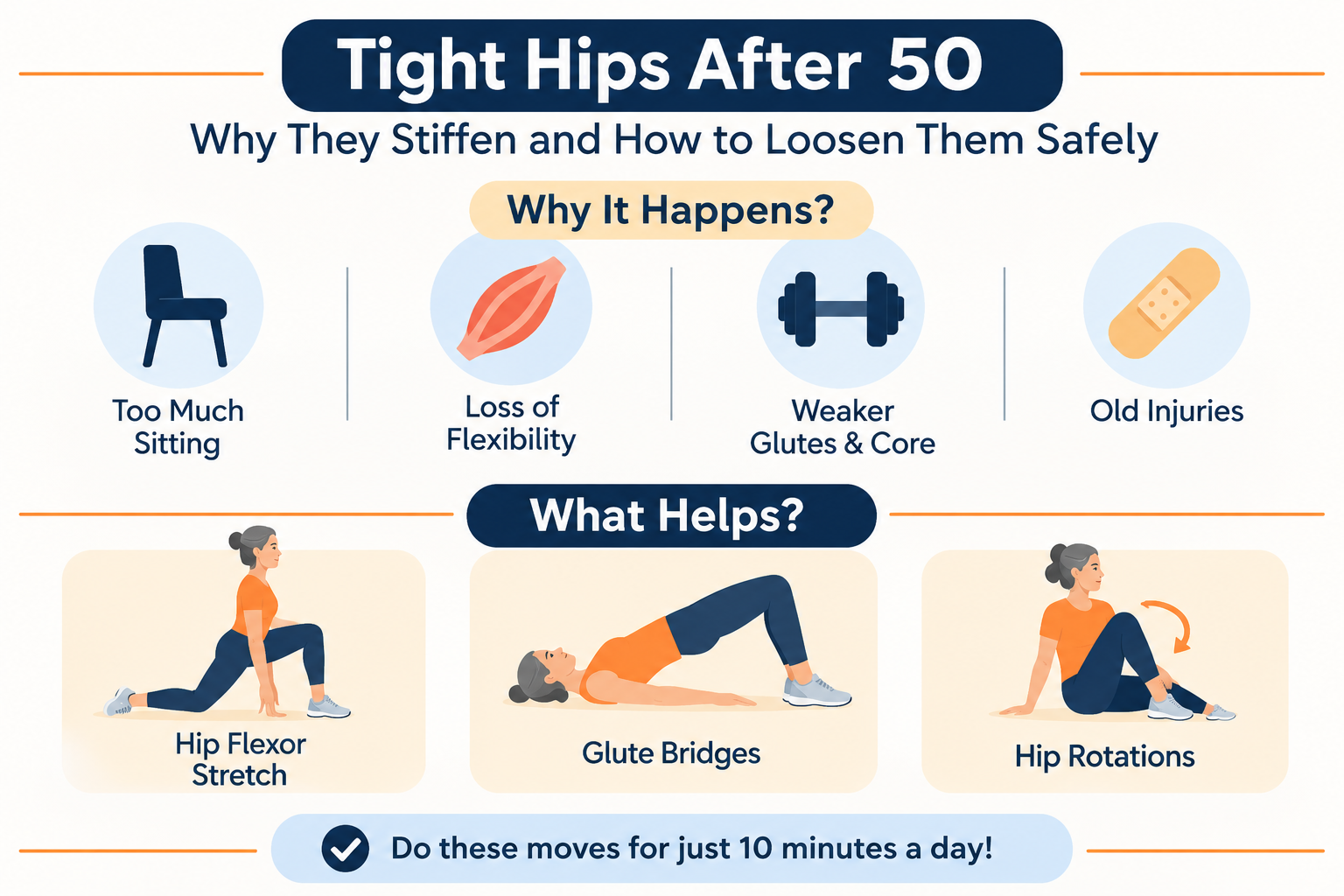
Four Moves That Loosen Stiff Hips
Skip the aggressive stretching. Go for slow, controlled movement that restores balance.
1. Open your hip flexors every day
Tight hip flexors cause more hip trouble in older adults than almost anything else. Try this:
- Step one foot back into a gentle lunge.
- Keep your torso tall.
- Tuck your hips slightly under.
- Hold for 20 to 30 seconds, then switch sides.
You should feel it in the front of the back leg. Not in your lower back. If you feel it in your back, ease off. Not sure how long to hold? Here’s how long to hold a stretch. For another gentle opener, try the butterfly stretch.
2. Wake up your glutes
Flexibility without strength fades fast. The glute bridge fixes that:
- Lie on your back with knees bent.
- Press through your heels.
- Lift your hips slowly.
- Squeeze your glutes at the top.
- Lower slowly.
Start with 8 to 10 reps. Stronger glutes make hip movement easier to keep.
3. Add slow rotation
Hips are built to rotate. Most of us stop asking them to. Standing rotations, supported lunges, and controlled leg swings bring that motion back. Move slowly. Breathe. Never force the range. Rotation is one of the first things people lose, so give it real attention.
4. Stay consistent
Here’s the mistake I see most. People do hip mobility exercises for a week, feel a bit better, and quit. Don’t. Ten minutes a day beats one long session on Sunday. Need a plan? Start with a simple daily stretching routine, and check the common stretching mistakes so you don’t undo your effort.
When Stretching Alone Isn’t Enough
Sometimes the issue is not a short muscle. It’s something else:
- Muscle imbalances
- Protective tension
- Fear of movement
- Not knowing what’s safe
That’s where a trained pair of hands helps. See how assisted stretching compares with stretching on your own, or how foam rolling stacks up against assisted stretching for hips.
At StretchPlex in Northern Delaware, we work with adults who want to move well without a loud gym. Our assisted stretching sessions are:
- One on one
- Calm and supportive
- Matched to your body
- Built around safety
Clients often tell us, “I thought this was just part of getting older.” After a few visits, many say they move easier, walk longer, sleep better, and feel steadier. Curious what a visit looks like? Read what to expect in your session, or check StretchPlex pricing. We have studios in Greenville, Hockessin, and North Wilmington.
Can Tight Hips Really Improve After 50?
Yes. Your body responds to new demands at any age. It just responds best to smart, steady input, not force.
So start gently. Move daily. Add strength. Get guidance if you stall. Ready for help? Book a session, visit www.stretchplexnow.com, or call 302-696-5966.
Your hips aren’t stuck. So what’s one stretch you’ll try tomorrow morning?
Frequently Asked Questions
Why do hips get so tight after 50?
Most people sit more as they age. Muscles and fascia lose some stretch. Glutes and core weaken too. Together, these changes cut hip movement and can leave the hips and lower back feeling stiff. Old injuries can add to it.
How do I loosen stiff hips after 50?
Go gentle and go daily. Hold a hip flexor stretch for 20 to 30 seconds per side, do glute bridges, and add slow hip rotations. Ten minutes a day works well. Stop if you feel sharp pain.
Can tight hips cause lower back pain?
Yes. When your hips don’t move well, your lower back often takes over the work. That extra load can cause aches and stiffness during walking, standing, and bending. Freeing up the hips often eases the strain.
How long does it take to improve hip mobility?
Many people notice a change within a few weeks of steady practice. Even 10 minutes a day helps. Connective tissue adapts slowly, so think in months for lasting gains.