
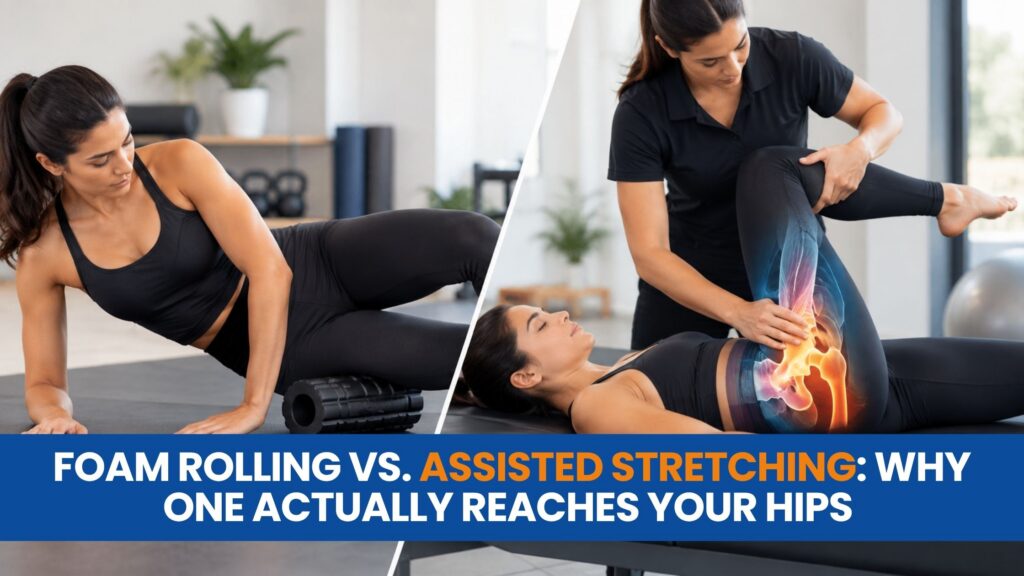
Assisted stretching reaches your hips better than foam rolling. A roller works mostly on the surface muscles you can lie on, like your quads and glutes. Your deep hip muscles and the joint itself sit too far inside and at the wrong angle. In assisted stretching, a trained pro moves and supports your leg, so those deep tissues can relax and open up.
You roll out after every workout. It feels great in the moment. But your hips still feel tight, your squat still pinches, and sitting for a long time still leaves you stiff.
That is not a willpower problem. It is a tool problem. Foam rolling and assisted stretching do different jobs. Once you see the difference, it is easy to know which one to use and when. If you are chasing deep hip mobility in North Wilmington, DE, this guide will save you months of guessing.
What Foam Rolling Does Well
Let’s be fair. A foam roller is a handy tool. It is cheap, easy to use at home, and it can make sore muscles feel better for a short time.
Rolling puts pressure on the surface of a muscle. That can ease that “knotted” feeling and help you warm up. Many lifters like it before a workout because it wakes the body up.
But the effect tends to be short. You roll, you feel looser for a bit, and then things settle back. It is a nice comfort tool. It is not a deep mobility fix. If you want to see how a proper guided session is different, look at how one is built from start to finish.
Why a Roller Struggles with Your Hips
Your hip is a deep ball-and-socket joint. It is wrapped in layers of muscle. Some of those muscles, like the hip flexors and the small rotators tucked under your glutes, sit deep inside.
A foam roller cannot get there well. You are lying on a cylinder and pressing down from the outside. The deep muscles are past a thick layer of tissue, and the angle is awkward. Rolling the front of the hip, where the flexors live, is also uncomfortable for many people.
There is another catch. Tight hips are not just about muscle. Joint position, pelvic tilt, and how your nervous system holds tension all play a part. A roller can only press on tissue. It cannot change how your brain lets the hip move.
Why Assisted Stretching Gets Deeper
With assisted stretching, you lie back and someone else does the moving. That one change matters a lot.
When you stretch alone, part of your body is always working to hold the position. That effort keeps your muscles switched on. When someone else supports your leg, you can breathe out and truly let go. A relaxed muscle can lengthen much more easily than a guarded one.
A trained stretch therapist also moves your hip in many directions. Forward, out to the side, and with a slight rotation. This reaches the deep hip muscles and the joint area from angles a roller never could. Every body is different, so the pro adjusts as they feel you respond.
Side-by-Side: A Simple Comparison
Here is a quick way to see the gap.
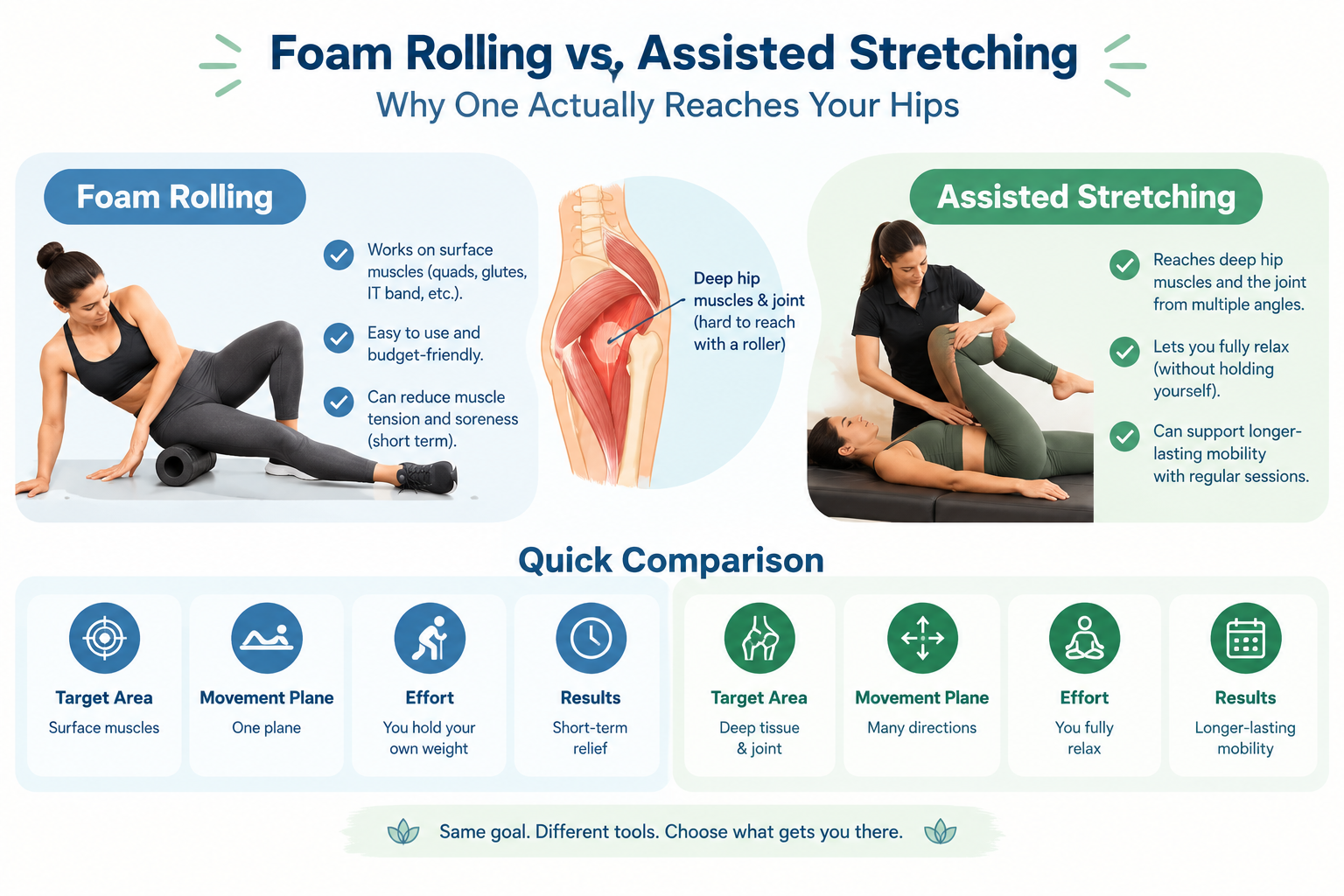
Foam rolling targets surface muscle, works in one plane, needs you to hold your own weight, and gives short-term relief.
Assisted stretching reaches deeper tissue, moves the hip in many directions, lets you fully relax, and can support longer-lasting range of motion when done regularly.
Neither one is “bad.” But if your goal is a wider range of motion at the hip, only one of them is built for it. StretchPlex offers a full menu of mobility and recovery services so you can match the tool to the goal.
The Hip-Hamstring Link
Here is why this matters for leg day. Your hamstrings attach to your pelvis. When your hips are stiff, the hamstrings get pulled tight and stay that way. You can stretch them all night and the pull from above wins.
That is the story we tell in our main guide, Why Your Hamstrings Stay Tight No Matter How Much You Stretch After Leg Day. Fix the hips, and the hamstrings often calm down too.
Your legs may also feel heavy between workouts. Tools like compression therapy and percussion therapy can help with recovery and leave your muscles feeling fresher.
The Best Plan: Use Both Wisely
You do not have to toss your foam roller. Use it for what it does well.
Before a workout: Roll for a minute or two to warm up. Follow with light movement.
After a workout: Keep it easy. Gentle walking and slow breathing help.
Once or twice a week: Book a guided session for deep hip work. This is where the big changes happen.
On off days: Add simple hip moves, like a lunge stretch and glute bridge, to keep gains going.
Pair this with smart strength work and you get more from every rep. Our personal training team can help you build a plan that fits.
Ready to Feel the Difference?
If your hips have felt stuck for months, a roller may not be enough. A guided session can show you what open hips actually feel like.
Start with a free stretching demo. Then review the session pricing and book your appointment when you are ready.
Frequently Asked Questions
Is foam rolling or stretching better for tight hips?
For deep hip tightness, stretching usually does more. A foam roller works on surface muscle, while stretching can reach deeper tissue and improve range of motion. Assisted stretching adds support, so you can relax more and go further.
Can foam rolling loosen hip flexors?
It can ease the surface of the muscle for a short time. But the deep hip flexors are hard to reach with a roller. Many people find guided stretching gives a stronger, longer-lasting release.
How often should I do assisted stretching for hip mobility?
Many people do well with one to two sessions a week at the start. Then they adjust based on training load and how they feel. Your stretch therapist can suggest a schedule that fits your goals.
Is assisted stretching safe for beginners?
Yes, for most healthy people. A trained practitioner works within your comfort range and adjusts as you go. If you have an injury or a medical condition, check with your doctor first.