
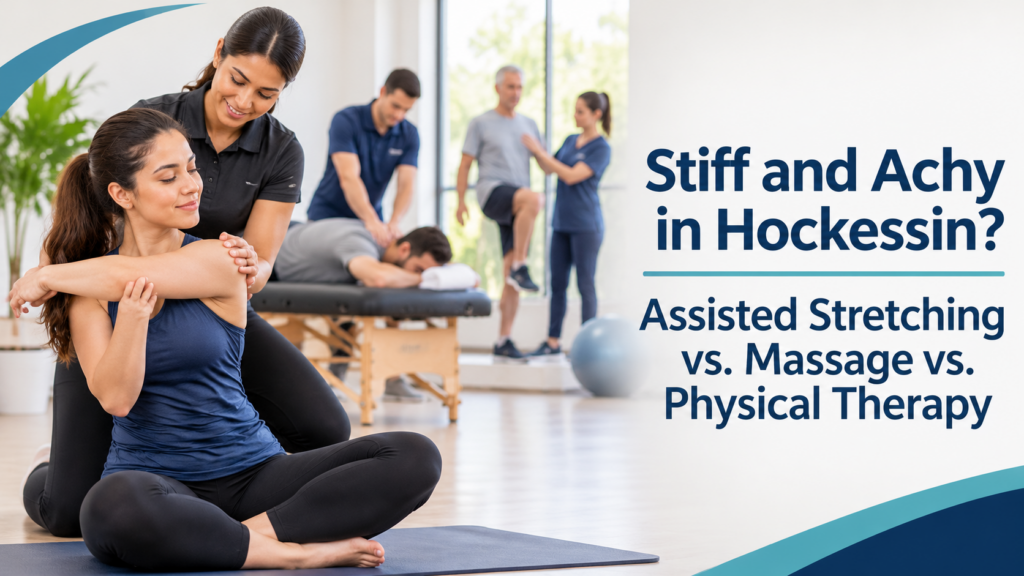
In the assisted stretching vs massage vs physical therapy decision, pick physical therapy for an injury, surgery, or pain with a cause to find. Pick massage for tense, tender muscles. Pick assisted stretching when you’re simply stiff and can’t move like you used to. Many Hockessin clients use two of the three.
You woke up stiff again. Your hips locked up after the drive down Route 41. Your shoulders feel like concrete by 3 p.m. So you started searching, and now three options all sound like they’d help.
They don’t do the same job. That’s the whole problem.
Assisted stretching vs massage vs physical therapy isn’t a contest. Each one goes after a different cause of tightness. Pick the wrong one and you’ll feel good for a day, then wake up stiff again. Pick the right one and things change.
We run assisted stretching in Hockessin, so we lean toward stretching. We’ll tell you where it falls short, too. Here’s what each option treats, why you may still be stiff, and how to match your situation to the right fit.
We wrote this from what we see at the studio and from how each service is set up. If you have an injury, a physical therapist or doctor has the final say.
What Each One Actually Treats (and Why You Might Still Be Stiff After Trying Them)
Stiffness feels like one problem. It isn’t. Three different things can cause it, and each treatment goes after a different one.
First, what kind of “achy” are you?
People use stiff, sore, and hurt as if they mean the same thing. They don’t, and the difference points you to the right fix.
Stiff means you can’t move as far as you’d like, a classic sign that sitting is hurting your mobility. It often eases once you warm up. Sore means the muscle is tender to the touch, usually after hard work, and it fades in a few days. Hurt is different. Sharp, one-sided, getting worse, tied to a fall, or waking you at night? That needs a professional’s eyes.
Most people who find us are stiff. A few are sore. Some are hurt and don’t know it yet.
Assisted stretching: joint motion and muscle length
Assisted stretching is a one-on-one session. A trained coach moves your body through guided stretches while you stay relaxed. A good coach can take you past the range you’d reach alone. Many use contract-relax methods, where you push gently and then let go.
It treats limited range of motion. Think tight hips from sitting, shoulders that won’t reach overhead, or that stuck feeling in your lower back when you stand up. A session feels like a deep, controlled stretch. It shouldn’t feel like pain.
It doesn’t treat injuries or nerve problems. Our coaches aren’t medical providers, and we say so up front.
Massage: tense, tender soft tissue
Massage works on soft tissue. That means muscle, fascia, and the knots people call trigger points. A therapist uses pressure to ease tension and calm things down. You lie still and let it happen.
It’s great for tender spots, stress, and sore muscles after a rough week. It’s less great for a joint that just won’t move through its full range. You can leave a traditional massage relaxed and still be unable to touch your toes.
Physical therapy: diagnosis, rehab, and strength
Physical therapists are licensed clinicians. They test how you move, work out why something hurts, and build a plan. The plan usually mixes exercises, hands-on work, and homework you do on your own.
If you’ve had surgery, a fall, a sports injury, or pain that shoots down a leg, start here. Care after an injury or surgery needs someone who can diagnose. It’s also the one of the three that insurance often covers. Your plan decides that.
The three side by side
| Assisted stretching | Massage | Physical therapy | |
| Main goal | More range of motion | Ease tight, tender muscles | Diagnose and rehab |
| Led by | Certified stretch coach | Licensed massage therapist | Licensed physical therapist |
| Your role | Relaxed, with some gentle pushing | Fully passive | Active: exercises and homework |
| Best for | Stiffness, desk body, staying mobile | Muscle tension, stress, soreness | Injury, surgery, pain with a cause to find |
| Can diagnose a problem? | No | No | Yes |
| Insurance? | Usually self-pay | Usually self-pay | Often covered; check your plan |
| Typical pattern | Regular visits, often weekly at first | As needed | A set plan over several weeks |
Not sure what’s covered? Our guide to stretch therapy uses, risks, and coverage lays it out.
Where each one falls short
No option is perfect. Assisted stretching can’t tell you why a joint hurts, and it won’t build strength. That’s a job for strength training or PT. Massage often wears off in days if your daily habits stay the same. Physical therapy asks the most from you. You have to do the homework, like a daily stretching routine, and that’s where many people drift away.
Knowing the weak spot helps you set fair expectations. It also tells you what to pair with each one.
Why you might still be stiff after trying them
Here’s the part most comparison pages skip. Plenty of people have already tried one of these and still feel stuck. Usually one of seven things is going on.
- You treated the wrong cause. Massage for a stiff joint. Stretching a muscle that’s really just weak and overworked.
- You went once. Gains in motion fade when nothing else changes. Sit for eight hours and you can undo a session by dinner. It happens faster than most people expect.
- Your nervous system is guarding. Much of the early gain in flexibility comes from your brain allowing more range. It isn’t always the muscle getting longer. If your body feels unsafe, it clamps down. Why stretching feels so good explains the science. [Add data point — suggested source: a peer-reviewed review on stretch tolerance]
- The pain isn’t where it hurts. Tight hamstrings can be an irritated back or nerve. Stretching harder just makes it angrier. That’s why a hands-on check matters.
- Weak feels like tight. An overworked muscle can lock up to protect you. More stretching won’t fix that. Strength work will.
- You’re sleeping badly. Poor sleep and a stiff body feed each other. The link is stranger than you’d think.
- You wanted a one-time fix. Tissue and habits change slowly. That’s true of all three options.
One Hockessin client wrote in a Google review that he finished PT after two knee replacements. Then he saw a coach weekly for eight or nine months to keep his flexibility. That’s the pattern we see most. PT first, then stretching programs for injury recovery to hold the gains.
Which One Do You Need? Match Your Situation
Choosing well saves you money and weeks of frustration. Start with safety, then match your symptoms to the table.
Step one: rule out the red flags
See a doctor or urgent care first if you have any of these:
- Numbness or tingling that spreads or keeps coming back
- Weakness in a leg or arm
- Pain after a fall or crash
- Back pain with a fever
- Trouble controlling your bladder or bowels
- One calf that’s swollen, warm, and sore
Chest pain or trouble breathing is an emergency. Call 911.
Step two: match your situation
| Your situation | Best first step | Why |
| Hips lock up after sitting or driving | Assisted stretching | It targets hip range of motion, and a coach can go further than you can alone |
| Knots in your neck and shoulders, plus stress | Massage | Pressure eases tense soft tissue |
| Recovering from surgery or an injury | Physical therapy | You need a diagnosis and a rehab plan |
| Finished PT but still feel tight | Assisted stretching, plus strength work | It helps you keep and build on the range you gained |
| Pain that shoots down a leg | Doctor or PT | A nerve may be involved |
| Stiff for golf or pickleball | Assisted stretching | Hips and shoulders drive your swing |
| Sore after hard workouts | Massage, or stretching with compression therapy | Both can speed up recovery |
| Tight and stiff in your 50s or later | Stretching plus strength | You want motion and muscle |
Want a closer look at your own case? Our guide to tight hips after 50 covers one of the most common complaints we hear.
A two-minute check you can do tonight
Pick one movement that bugs you. Maybe it’s reaching overhead, turning to check your blind spot, or getting up from the couch. Note how far you get today. Test the same move once a week.
If it improves with whatever you try, keep going. If it doesn’t budge in three or four weeks, change the plan. Stop at once if you feel sharp pain, and don’t push through it. Tracking one move beats guessing.
When two beats one
Honestly, the best answer is often a mix. PT first, if you’re injured. Stretching after, once your therapist says it’s fine. Some people book a massage to calm tender tissue, then stretch to use that window of looser muscle.
We work alongside physical therapists, chiropractors, and doctors when a client needs that. If something looks off, we’ll send you to one before we stretch anything. Strength work helps too, so many clients add personal training once they’re moving better.
Five questions to ask before you book anyone
Whoever you pick, ask these first. Who will work with me, and what’s their training? Will you assess how I move before you start? What’s the plan, and how will we know it’s working? What happens if something hurts? And will you talk to my doctor or therapist if I ask?
A good provider answers without fuss. If you get vague answers, keep looking.
What a first visit looks like in Hockessin
You’d come to 722 Yorklyn Rd., Suite 200, in the Stone Mill office park. Wear loose, stretchy clothes. Skip the jeans. Your coach asks about your goals, then guides you through stretches built around your body that day.
The $19 intro session needs no membership. If you’re not happy with it, your next session is on us. You can book online or call (302) 696-5966.
Our view is simple. If you’re just stiff, start with the cheap session. It’s the fastest way to learn what your body is doing. And if you’re hurt, see a PT first. We’d rather lose a booking than stretch the wrong thing.
Frequently Asked Questions
Is assisted stretching better than massage?
Neither is better. They do different jobs. Massage eases tense, tender muscle. Assisted stretching works on how far your joints move. Still torn? Our breakdown of whether assisted stretching beats massage goes deeper.
Can assisted stretching replace physical therapy?
No. A physical therapist can diagnose a problem and treat an injury. A stretch coach can’t. Assisted stretching works well after PT, or alongside it with your therapist’s okay.
Should I do PT or assisted stretching first?
If you’re injured, in pain, or recovering from surgery, do PT first. If you’re simply stiff and nothing is wrong, stretching is a fine place to start.
How many sessions until I feel a difference?
Many people feel looser after one visit. Lasting change usually takes regular visits over several weeks. It varies with your age, your habits, and how long you’ve been stiff. Regular rates are on our pricing page.
Does insurance cover assisted stretching?
Usually not. Most stretching and massage visits are self-pay, while PT is often covered. Call your insurer to confirm, since plans differ.
Is assisted stretching painful?
It shouldn’t be. You’ll feel a strong stretch, and that’s normal. Sharp pain isn’t. Tell your coach right away. Some mild soreness the next day can happen.
Is it safe after a knee or hip replacement?
Often, yes, but get your surgeon or PT to clear you first. Many of our clients come after finishing rehab. Your coach works within the limits your care team gives.
Which should I pick if I sit at a desk all day?
Start with assisted stretching for the hips and back, and add strength work to hold the change. Then fix the habit, too. Our post on desk job stiffness in Hockessin shows how fast sitting undoes your progress.