
Whenever I get a massage, I leave feeling amazing… only to wake up two days later just as stiff as before!
A question we get a lot is:
“Do I actually need a massage… or do I need stretching?”
That’s where stretch massage and assisted stretch sessions are becoming incredibly popular, especially for adults over 40 who feel tight, stiff, achy, or restricted in daily life.
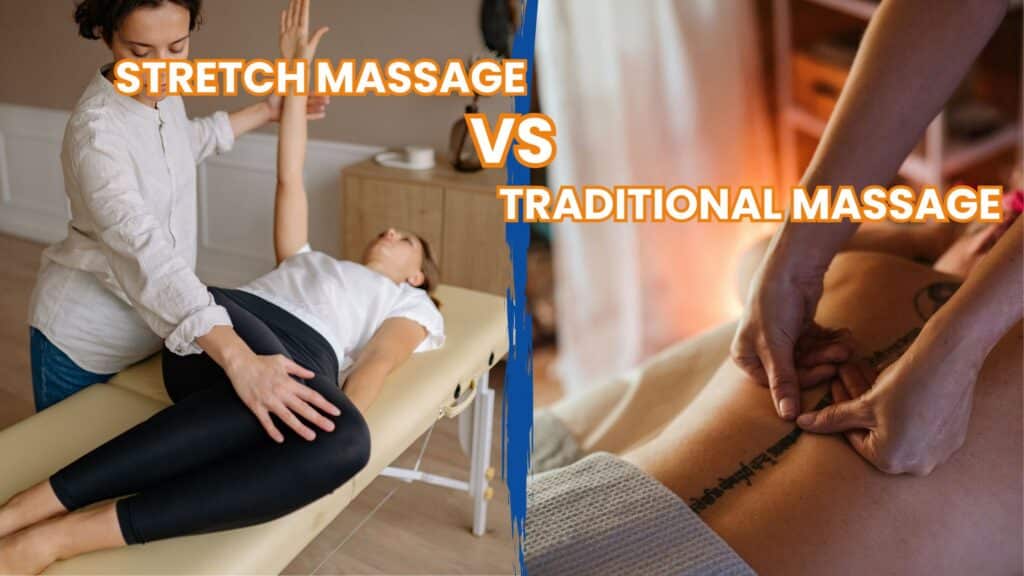
While traditional massage and assisted stretching can both help you feel better, they work very differently. One focuses mostly on relaxing muscles. The other focuses on improving how your body moves.
And depending on your goals, one may be a much better fit for you.
What Is a Stretch Massage?
A stretch massage combines hands-on muscle work with guided stretching techniques to help improve flexibility, mobility, and muscle function. This may include the use of a massage gun or other tools for soft tissue work.
Unlike a traditional massage where you mostly lie still, a stretch massage involves movement. A trained stretching specialist gently moves your body through specific positions and assisted stretch techniques designed to help muscles lengthen and joints move more freely.
At places like StretchPlex, these sessions are completely customized based on how your body feels and moves.
Many people use stretch therapy for:
- Tight hips
- Lower back stiffness
- Neck and shoulder tension
- Poor posture
- Athletic recovery
- Difficulty bending or reaching
- General aging-related stiffness
A lot of clients say they feel “lighter” or “looser” immediately afterward because the body is moving better, not just relaxing temporarily.
What Does Traditional Massage Do?
Traditional massage is primarily focused on muscle relaxation and tension relief.
Massage therapists use pressure, kneading, and soft tissue techniques to:
- Increase circulation
- Reduce muscle tension
- Promote relaxation
- Calm the nervous system
- Help with stress
Massage can absolutely be helpful, especially if stress is a major factor in how your body feels.
If your shoulders are tight from anxiety or your body feels run down after a stressful week, massage may be exactly what you need.
But here’s the important distinction:
Massage usually does not actively improve flexibility or range of motion long term unless stretching or movement work is also involved.
That’s why many people find themselves repeatedly going back for relief without fully solving the stiffness problem underneath.
The Biggest Difference: Relaxation vs Movement
The simplest way to think about it is this:
Traditional massage focuses more on relaxation.
Assisted stretch focuses more on movement and mobility.
That difference matters more than most people realize.
If your body feels:
- Stiff getting out of bed
- Tight when golfing
- Restricted while walking
- Limited reaching overhead
- Uncomfortable after sitting
- Less mobile than you used to be
…then mobility may actually be the real issue.
And that’s where assisted stretching benefits tend to stand out.
Why More Adults Are Choosing Assisted Stretch Sessions
One of the biggest reasons people are switching from traditional massage to stretch therapy is convenience.
With many massage appointments:
- You undress
- Oils or lotions are used
- You may need to shower afterward
- Hair and makeup can get messy
- It can feel difficult to fit into a workday
With assisted stretch sessions:
- You stay fully clothed
- No oils are used
- Sessions are clean and simple
- You can come before or after work
- The focus is active improvement
That makes professional stretching services feel much more practical for busy adults.
A client at StretchPlex recently explained it perfectly:
“I used to get massages every month because my back always tightened up again. After a few assisted stretch sessions, I realized my hips and hamstrings were actually the problem. I move so much better now.”
That’s a very common experience.
Can Stretching Actually Help Longer Term?
In many cases, yes.
Massage often helps symptoms temporarily.
Stretching helps improve how the body functions.
When muscles stay tight for long periods of time, they can begin limiting movement patterns throughout the body. Over time, that can affect posture, balance, walking, exercise, and even energy levels.
Guided stretching and mobility stretching can help:
- Improve flexibility
- Increase range of motion
- Reduce muscular tightness
- Improve posture
- Support better movement patterns
- Help you feel more active and capable
That’s especially important as we age.
Many adults assume stiffness is “just part of getting older,” but often the body simply hasn’t been moving properly for years.
What About a Stretch Class?
A stretch class can absolutely help, especially if you already move fairly well and enjoy group fitness environments.
But there’s a big difference between a stretch class and one-on-one assisted stretch therapy.
In a stretch class:
- Everyone does similar movements
- The instructor cannot fully customize the session
- There’s limited hands-on guidance
With assisted stretching:
- The session is personalized
- Tight areas are identified individually
- The stretch specialist adjusts based on your mobility
- You can often stretch deeper safely because the work is assisted
For people with significant stiffness, previous injuries, or mobility limitations, one-on-one stretching is often much more effective.

So… Which One Do You Need?
The answer depends on your goal.
Traditional massage may be best if you want:
- Stress relief
- Relaxation
- A calming experience
- Temporary muscle relief
Stretch massage or assisted stretch therapy may be better if you want:
- Better flexibility
- Improved mobility
- Easier movement
- Long-term improvement
- Less stiffness
- Better athletic performance
- Help staying active as you age
And honestly, many people benefit from both.
Massage and stretching do not have to compete with each other. They simply serve different purposes.
But if you constantly feel tight, restricted, stiff, or less mobile than you used to, your body may be asking for movement more than relaxation.
Frequently Asked Questions
What is the difference between stretch massage and traditional massage?
A stretch massage focuses on improving mobility, flexibility, and movement through assisted stretching techniques, while traditional massage mainly focuses on relaxation, circulation, and relieving muscle tension.
Is assisted stretching better than massage for stiffness?
For many people dealing with long-term stiffness or limited mobility, assisted stretching can provide longer-lasting improvement because it helps improve movement patterns and flexibility rather than only relaxing muscles temporarily.
How often should you get a stretch massage?
This depends on your goals and activity level. Many people benefit from assisted stretch sessions once or twice a week, especially if they experience tight muscles, poor mobility, or postural stiffness.
Can stretch therapy help improve flexibility and posture?
Yes. Stretch therapy and mobility stretching can help improve flexibility, increase range of motion, reduce tightness, and support better posture and overall movement over time.