

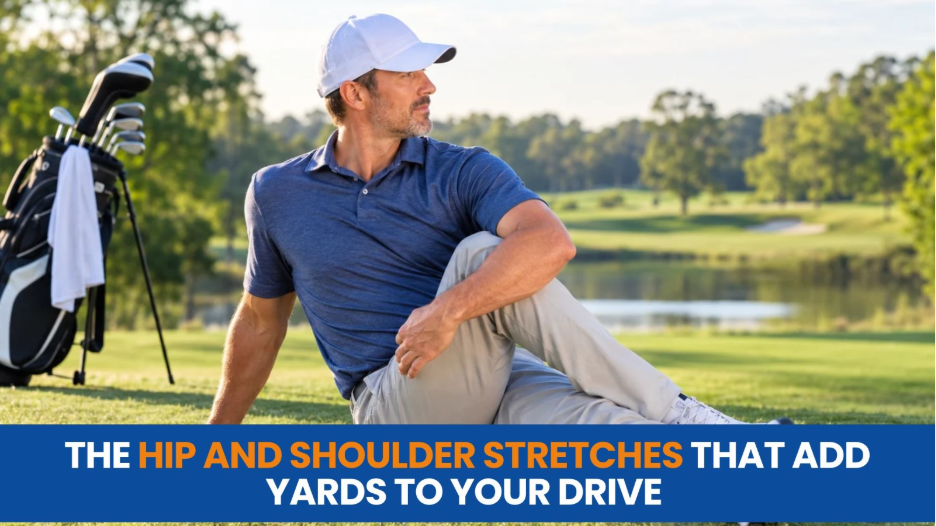
Be honest: how many times have you hit what felt like a perfect drive, only to find it a good bit short of your playing partner’s? Yeah, us too. Any decent stretch therapist will tell you the problem usually isn’t the driver. It’s a pair of stiff hips and an upper back that won’t turn.
Think about what is happening. When your hips can’t rotate and your upper back is locked up, your arms take over, and arms just aren’t built to make that kind of speed on their own. No new shaft is going to fix that.
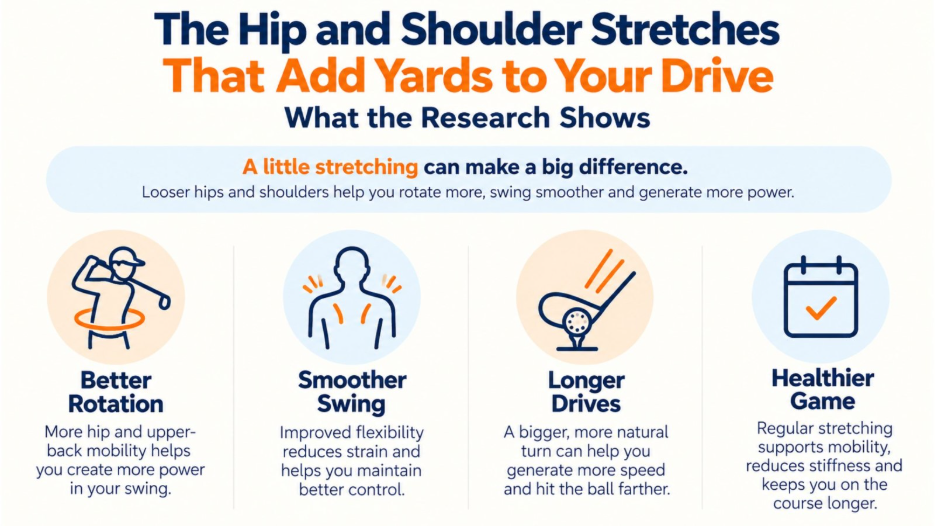
It’s a big reason golf flexibility keeps coming up in conversation around Greenville. Loosen up the hips and shoulders, and the swing gets easier. A lot of the time, the ball goes farther too.
Where your distance really comes from
Here’s the simple version of how a swing makes power. Your hips turn a bit on the way back, your shoulders turn more, and that gap works like a wound-up rubber band. Then you let it go.
Stiffen up the hips and the band never gets fully wound. Lock up the upper back and you either shorten your backswing or lift your arms to cheat a bigger turn. You lose speed both ways, and your lower back usually complains afterward.
Now, we’re not going to tell you a few stretches will add 30 yards by Saturday. They won’t. What they can do is let you turn bigger and smoother without forcing it, and that’s where extra distance tends to come from.
Three hip stretches worth your time
Take each one slowly. Hold for 30 to 45 seconds, breathe, and stop when you feel a gentle pull. Sharp pain means you’ve gone too far.
- The 90/90 hip switch. Sit on the floor with both knees bent at 90 degrees, one leg out in front and the other off to the side. Sit tall, lean a bit toward the front shin, then swing your knees over to the other side. It’s a little awkward the first few times, but it trains the same hip rotation as your backswing and follow-through rely on.
- The half-kneeling hip flexor stretch. Kneel on one knee with your other foot planted out front. Keep your chest up and gently shift your hips forward. Spend all week at a desk, then sit in the car to get to the course? Your hip flexors are probably tight, and tight ones make it harder to turn and finish.
- The butterfly stretches. Sit down, press the soles of your feet together, and let your knees fall out to the sides. It looks like something you’d do in grade school, but it opens up the inner hips nicely. If your lower back or hips are always grumbling, here’s why the butterfly stretch belongs in your routine.
Tight hamstrings and glutes too? Our leg stretches guide goes well with these.
Three shoulder and upper-back stretches
Your shoulders can only turn as far as your upper back lets them, so these three go after both.
- The open book. Lie on your side, knees bent, arms out in front of you. Sweep the top arm up and over as if you’re opening a book, rolling your chest toward the ceiling while your knees stay stacked. Let your eyes follow your hand. It frees up your thoracic spine, which is the part of your back that should be doing most of the turning in your swing.
- The crossbody shoulder stretch. Reach one arm across your chest and pull it in gently with the other hand. Keep your shoulders down and relax. It works at the back of the shoulder, which is usually where the pinch shows up at the top of your backswing.
- The doorway chest stretch. Rest your forearm on a door frame, elbow at shoulder height, and step through a little until your chest and the front of your shoulder open up. When your chest is tight and rounded, it’s hard to turn fully and stand tall at the finish.
When to stretch, and when not to
One thing about timing is that. These long holds are best after a round, on rest days, or in the evening. Right before you tee off, your body wants to move, not sit in a stretch.
At the range or the first tee, dynamic stretching is the better call. A few easy practice swings, some leg swings, and torso twists will warm you up without making you feel sluggish.
And if you’re a little sore the next day after trying something new, relax. That’s pretty normal. We explain why you can feel sore after stretching and when it’s worth paying attention to.
Going solo or getting a hand
Stretching alone works, and lots of golfers do well with ten minutes a few times a week. The problem is we all end up doing the stretches that feel good and skipping the ones that are actually stuck. And honestly, we quit just when a stretch starts to do something.
That’s the gap a trained pro can fill. In assisted stretching, your therapist guides you through each position and controls the angle and pressure, so you can just relax and go deeper than you would on your own. Curious what it’s like? Here are the benefits of assisted stretching with a trained professional.
For golfers, we put extra time into the hips, thoracic spine, shoulders, and hamstrings, so you end up with personalized stretching programs instead of a generic routine. It’s a good fit for older golfers too, since stretching exercises for seniors can be adjusted to keep you out there comfortably for years.
After a long weekend on the course, compression therapy for legs can do wonders for tired legs, and it pairs well with a stretch session. If you want the bigger picture of how we work, here’s what makes us a wellness recovery center.
Want to build on your flexibility? Take a look at our strength and flexibility training. And if you like the idea of a regular plan, check out the wellness of package pricing.
A routine you’ll actually stick with
You don’t need an hour. Start with this:
- 2 to 3 days a week: Choose two hip stretches and two shoulder stretches from above. Hold each for 30 to 45 seconds per side.
- Before you play: Skip the long holds. Do about 5 minutes of easy, active movement.
- Once or twice a month: Book an assisted session for the spots you can’t get to yourself.
Give it four to six weeks. Most golfers notice they turn more easily and wake up less stiff, and that little catch at the end of the swing starts to disappear.
One Honest caution
Quick honesty: stretching helps most people, but it isn’t magic and everyone’s body is different. If you have a recent injury, ongoing pain, or a medical condition, check with your doctor or physical therapist first. And never force a stretch into sharp pain.
The bottom line
Before you spend money on another driver, shaft, or grip, give the body swinging it a few weeks of attention. Looser hips and a freer upper back mean a bigger turn, a smoother swing, and a back nine that doesn’t hurt.
Want to work on your golf flexibility in Greenville? Book a session, tell us about your game, and we’ll build something around your swing.
FAQs
- Can stretching really help me hit the ball farther?
It can help, but it’s not a magic trick. Better hip and upper-back mobility lets you make a bigger, smoother turn without forcing it, and that often shows up as more clubhead speed. Results vary from golfer to golfer. - How often should I stretch for golf?
Two to three short sessions a week is a good place to start. Ten to fifteen minutes is plenty, as long as you actually do it. Consistency beats one marathon session every few weeks. - Should I stretch before or after a round?
Both, just differently. Before you play, stick to easy, active movement like practice swings and torso twists. Save the long, held stretches for after your round or for rest days. - Is assisted stretching worth it for golfers?
If you tend to skip the tight spots when you stretch alone, it can be. With assisted stretching, a trained therapist handles the positioning, so you can relax and work on the areas that limit your swing most.