



Your walking pattern shows how well your joints, muscles, and nerves work together. A new limp, short steps, or a drifting hip can point to pain, weakness, stiffness, or a nerve problem. Muscle imbalances may play a part, but a healthcare provider has to find the real cause.
Most of us never think about how we walk. You head to the mailbox. You cross a parking lot. You follow the dog around the block while your mind is somewhere else.
Lately I’ve caught myself walking differently. My stride shifts with the hour, the day, even the floor under my feet.
Then it hits you. One leg feels a little wobbly. Your steps get shorter. Someone asks why you’re limping, and you had no clue. When my partner said it on one of our walks, I got defensive.
That reaction told me something. A change in your walk deserves a second look, even a small one.
What gait abnormality actually means
Gait is simply the way you walk. A gait abnormality is any change or problem in that pattern, like limping, dragging a foot, or having trouble with your steps. We all have our own style. Walking unlike your neighbor isn’t a red flag.
You don’t need to check yourself in a mirror each morning. What counts is a shift from your own normal, mostly if walking starts to hurt or feel harder. Maybe the stroll you used to love now feels like a chore. That’s a good reason to ask for help.
Muscle imbalances: a phrase that sounds smarter than it is
The term muscle imbalances is broad. It can mean one side is stronger than the other. It can mean two muscles that work as a team don’t share the load evenly.
So when someone says you have an imbalance, ask three things. Which muscles? How did they measure it? And how does it connect to the thing you’re struggling with?
Here’s one clear case. Muscles around your hips keep your pelvis level as you step. When they’re weak, your pelvis can drop on the opposite side. Doctors call this a Trendelenburg gait. Other hip problems can cause it too. Stiff hips can change how you move as well.
Don’t worry about the name. Just know that strength shapes your stride. Finding the cause takes a real exam.
Three changes that deserve a closer look
You’re favoring one leg
Picture a sore knee that has lingered for weeks. Without a choice, you ease off that side. Your steps come out uneven. Pain does that. It doesn’t prove one muscle is tight and another is weak.
If you notice a limp, write down when it shows up. Is it there from step one? Or only after ten minutes? Your provider will love that detail. Knee pain that flares on stairs is a common version of this story.
Your hips sway more than they used to
A sideways lean or a dipping pelvis can go with weak hip muscles. But watching yourself walk won’t tell you which muscle or joint needs help. So skip the exercise video that looks like your walk. Two different problems can look the same from the outside.
Your feet don’t clear the ground
Dragging your feet, shuffling, taking small steps, or moving stiffly are all walking problems. Causes include joint disease, injuries, and nerve or brain problems. Don’t blame every one of them on weak or tight muscles.
Catching your toes or feeling unsteady? Put safety first and arrange an exam.
Collect facts before you try to fix anything
Think of four daily moments. Walking from your car into a store. Turning around in your kitchen. Stepping up or down a curb. Your usual loop around the block.
Notice pain, tiredness, doubt, or a clear gap between your left and right side. Don’t turn it into a balance test. There’s no need to stand on one foot without support.
Keep a short log. When did the change begin? What eases it, and what makes it worse? A clinician may check your strength, balance, and how your joints move. That beats guessing every time.
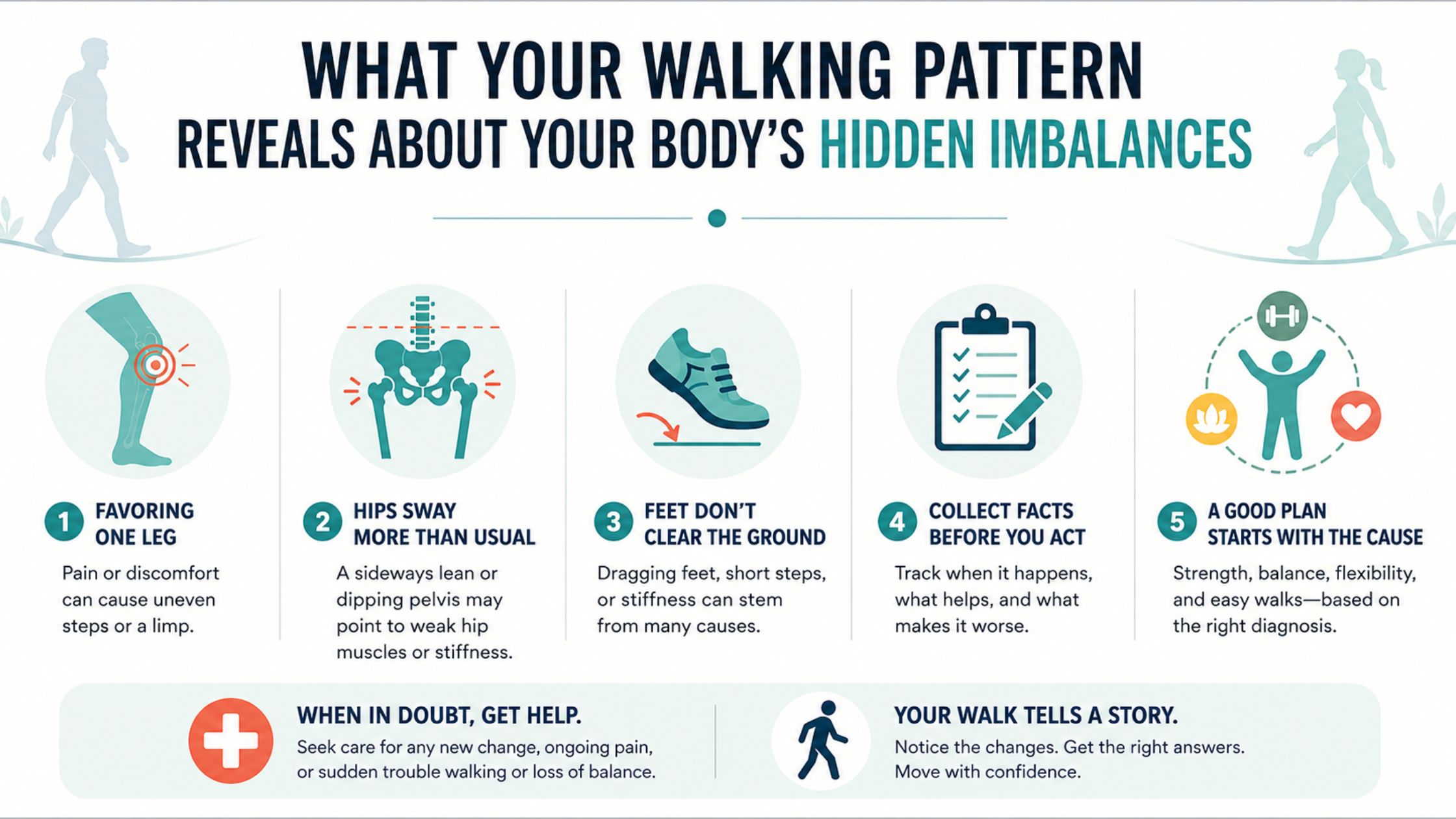
A good plan starts with the cause
Wondering how to improve your walking gait? Begin with why it changed. Care may mean physical therapy, new shoes, or treating a health issue behind it.
Once you have a green light, your routine might include strength work for muscles that need backup. It might add balance practice that fits your level. Flexibility work helps where motion feels tight. Walks at an easy, steady pace round it out.
The National Institute on Aging suggests mixing strength, balance, flexibility, and endurance.
Stretching helps with flexibility. Strength and balance need their own time. Your plan should match what you want to do with ease. Maybe that’s a round of golf. Maybe it’s keeping up with the grandkids.
When walking trouble is an emergency
Book an exam for any new change in your walk, ongoing pain, or balance trouble.
Sudden trouble walking or a sudden loss of balance can be a stroke sign. Call 911. Worry more if you also have weakness on one side, a drooping face, trouble speaking, or a vision change. Don’t wait for a stretching appointment.
Tell us what changed
At StretchPlex, “I want to walk more comfortably” is a fine goal. “My left leg feels shaky on stairs” is even better. It gives us more to work with.
Our Body Coaches offer assisted stretching and personal training in North Wilmington, Greenville, and Hockessin. We can help you build flexibility and strength within a plan built around your goals. Diagnosing walking changes belongs with a healthcare provider.
Visit stretchplexnow.com to see our services. Tell us what you want to feel easier, and share any safe-movement advice you’ve already had.
So what has changed in your walk?
FAQs
What causes an abnormal gait?
Many things can. Pain from an injury or arthritis is the most common reason, and it often shows up as a limp. Weak muscles, joint problems, foot trouble, inner ear issues, and nerve or brain problems can also change your steps. The causes overlap, so a provider needs to examine you.
Can muscle imbalances change the way you walk?
They can play a role. Weak hip muscles, for example, may let your pelvis dip as you step. Still, a limp or a lean has more than one possible cause, including pain, joint disease, and nerve problems. So treat an imbalance as one possibility, not a diagnosis.
Can stretching or exercise fix an abnormal gait?
Sometimes they help, but only after you know the cause. Care may include physical therapy, shoe changes, or treating an underlying condition. Once a provider clears you, a plan with strength, balance, flexibility, and easy walks can help you move better. Stretching alone won’t cover all of that.
When should I see a doctor about how I walk?
Book a visit for any new change in your walk, ongoing pain, or balance trouble. Call 911 right away for sudden trouble walking or sudden loss of balance. Worry more if you also have weakness on one side, a drooping face, slurred speech, or vision changes. These can be stroke signs.
Sources
Cleveland Clinic: Gait Disorders and Abnormalities. https://my.clevelandclinic.org/health/diseases/21092-gait-disorders
Cleveland Clinic: Trendelenburg Gait. https://my.clevelandclinic.org/health/diseases/trendelenburg-gait
MedlinePlus: Walking Problems. https://medlineplus.gov/walkingproblems.html
National Institute on Aging: Exercise and Physical Activity for Older Adults. https://order.nia.nih.gov/sites/default/files/2023-10/exercise-physical-activity-brochure.pdf
CDC: Signs and Symptoms of Stroke. https://www.cdc.gov/stroke/signs-symptoms/index.html