

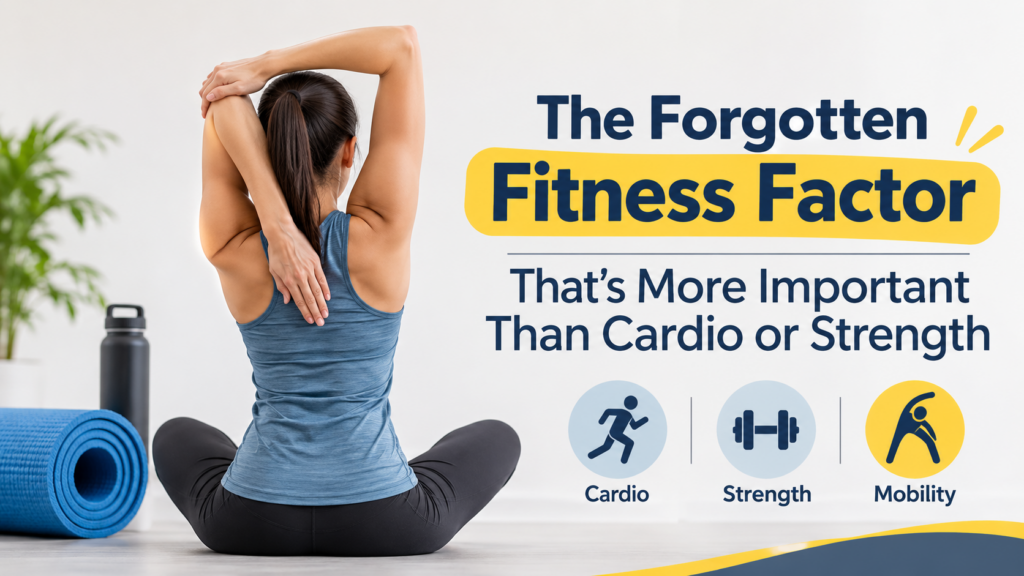
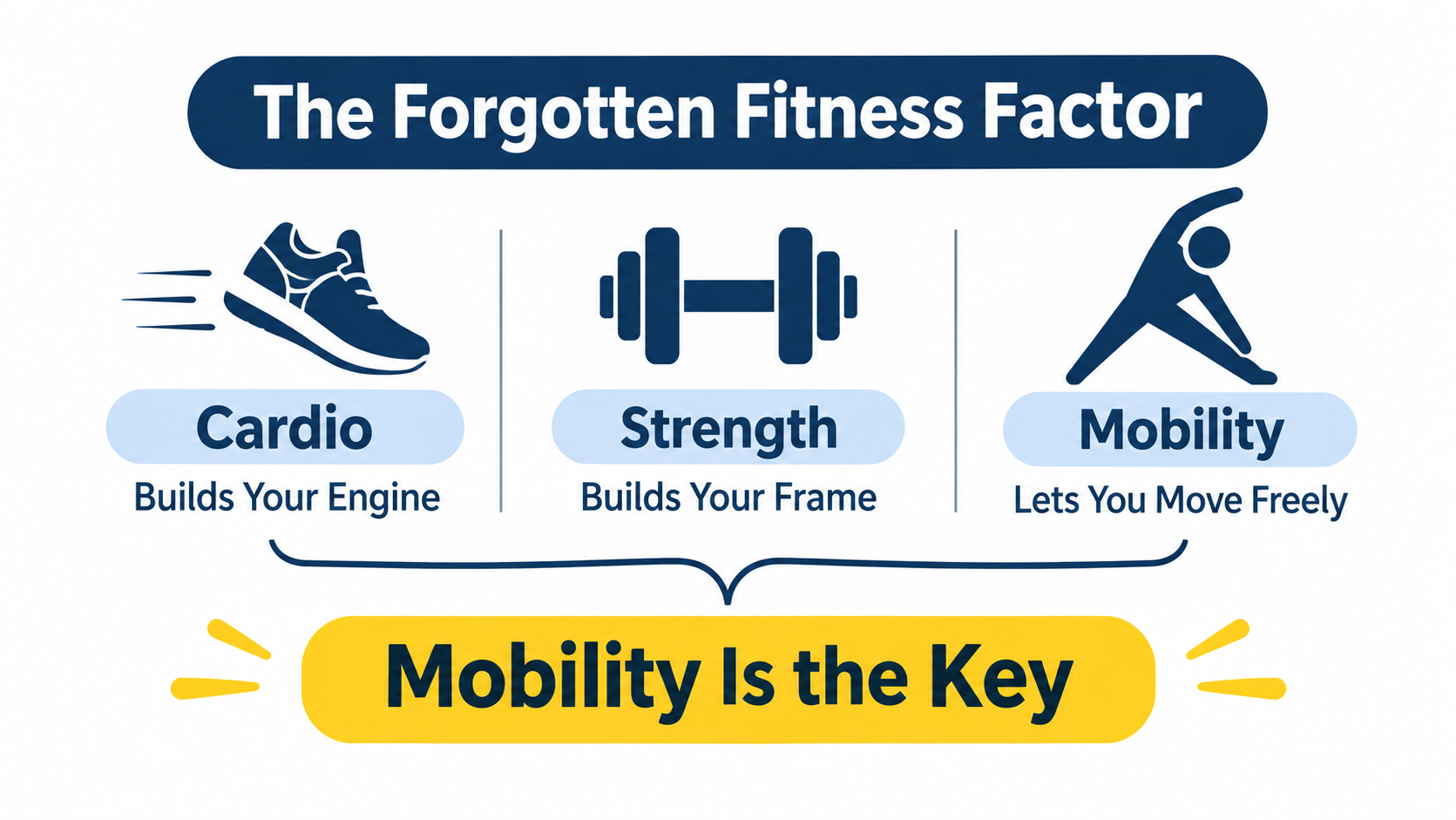
The forgotten fitness factor is mobility, meaning how freely and safely your joints move through their full range. Cardio builds your engine and strength builds your frame, but both depend on mobility. Without it, you move poorly, lift poorly, and get hurt more often.
You can run a 5K. You can deadlift your bodyweight. And you still can’t sit cross-legged on the floor without a groan.
That gap matters.
Most training plans split fitness into two camps: cardio for the heart, strength for the muscles. Both earn their spot. But a third piece rarely makes the whiteboard, and it decides how much the other two actually pay off. It’s mobility, and it sits right at the centre of flexibility and mobility in your daily routine. Ignore it, and you’re building a fast car with seized wheels.
Mobility Isn’t Just Flexibility
People mix these two words up all the time. Flexibility is how far a muscle can lengthen. Mobility is how well a joint moves through its range while you stay in control of it.
Think of a dancer doing the splits. That’s flexibility. Now think of someone squatting deep with a flat back, open hips, and heels on the floor. That’s mobility, and it asks more of you: muscle length, joint health, strength at the end range, and a nervous system that trusts the position.
Some of this is luck. Why some people are naturally flexible comes down partly to genes, bone shape, and connective tissue. But luck isn’t the whole story. Range of motion responds to training, even if you start stiff.
Why Cardio and Strength Both Hit a Ceiling
Here’s the problem. A stiff joint doesn’t stop working. It just borrows movement from the joint next door.
Tight hips? Your lower back starts rotating more than it should. Stiff ankles? Your knees cave in during a squat. Locked-up upper back? Your shoulders take the hit on every overhead press. The body is clever, and it will find a way to get the rep done, even when that way is a bad one.
Repeat that pattern a few hundred times a week and something eventually complains. If your legs feel like wood after training, look at why hamstrings stay tight after leg day. Often the muscle isn’t weak. It’s guarding a joint that can’t move well.
Cardio hits the same wall. A runner with limited hip extension shortens their stride and loads the calves and knees harder. A cyclist who can’t hinge at the hip ends up with a sore neck by mile twenty. More fitness on top of poor movement just means more wear on the same weak spots.
Signs Your Mobility Is Lagging
You don’t need a lab test. Your body drops hints all week long. Here are some common ones, along with what they often point to.
| What you notice | What it may point to |
| Heels lift when you squat | Tight ankles or calves |
| Arms can’t reach straight overhead | Stiff upper back or shoulders |
| Lower back aches after standing | Tight hip flexors |
| Hard to turn your head to check traffic | Stiff neck and upper spine |
| Sore knees on stairs | Poor hip or ankle movement |
These aren’t diagnoses. Pain that sticks around deserves a visit with a doctor or physical therapist. Still, a list like this is a handy early warning. Our guide on the signs that sitting is wrecking your mobility goes deeper on what to watch for.
The Sitting Problem Nobody Trains Against
Most adults sit for hours a day. Hips stay bent. Shoulders round forward. The chest closes. Your body adapts to whatever position you give it most, and sitting is a position it learns very well.
That’s why a gym session can’t fully cancel out a desk day. One hour of training against eight hours of folding yourself into a chair is a lopsided trade. Read more on why desk jobs create stiff, stooped bodies if this sounds familiar.
Age makes it louder. Joints and connective tissue change over time, and hips are often the first to complain. If you’re past fifty, the piece on tight hips after 50 lays out what changes and what helps.
And if you skip stretching for years? Things get stiffer in a fairly predictable order. We mapped that out in what happens to your body if you never stretch.
Warm-Up Is Not the Same as Stretching
This is where many gymgoers slip. They hold a long stretch before lifting, feel loose, and assume that counts as prep. It doesn’t, quite.
A warm-up raises your temperature and wakes up the nervous system. Stretching changes how far a tissue is willing to lengthen. Different jobs. Our breakdown of the differences between warming up and stretching explains how to use each one at the right time.
Before training, movement-based prep usually fits best. Here’s how dynamic stretching helps you prepare for activity. Save the longer holds for after your session or for a separate block later in the day. Some research suggests very long static holds right before heavy lifting can dull power for a short time, so timing counts.
A Five-Minute Mobility Routine You Can Start Today
You don’t need an hour. You need a habit. Try this sequence and breathe slowly through each move.
- Cat-cow, 8 slow rounds. Wakes up the spine.
- Deep bodyweight squat hold, 30 seconds. Hold a door frame if you need help.
- Half-kneeling hip flexor stretch, 30 seconds per side. Squeeze the glute of the back leg.
- Thoracic rotation on all fours, 6 reps per side. Open the upper back.
- Wall ankle rock, 10 reps per side. Knee travels over the toes.
That’s it. Do it daily, and you’ll feel a difference in a couple of weeks. Not because it’s magic, but because small doses add up. If you want a fuller plan, our daily stretching routine builds on this idea.
As for how long to hold each stretch, many guidelines suggest around 30 seconds. Our post on how long you should hold a stretch to increase flexibility digs into the numbers.
When Self-Stretching Stops Being Enough
Some people stretch for months and barely budge. It’s frustrating. Often the limit isn’t muscle length at all. It’s your nervous system putting on the brakes, because it doesn’t feel safe letting a joint go further.
That’s where a trained partner helps. A practitioner can guide a limb past the point where your body would normally tense up, and they can do it safely and slowly. You can compare the two paths in assisted stretching vs. self-stretching, or read through the benefits of assisted stretching to see if it fits your goals.
Sleep plays a part too. A tired, tense body resists change. There’s a strange two-way link, covered in the weird link between poor sleep and a stiff body.
It’s Not Cardio vs. Strength vs. Mobility
Let’s be honest here. The headline is a bit cheeky. Your heart still needs work, and your muscles and bones need load. Nobody should drop the barbell for a yoga mat.
The real point is about order and balance. If your joints can’t reach the positions your training demands, extra cardio and extra weight just stack stress on weak links. Fix the movement first, and every other kind of training gets safer and more productive.
Curious whether stretching helps with size, too? The evidence is more mixed than social media suggests. This look at what the research shows on stretching and muscle growth separates fact from hype.
Here’s my take: give mobility ten minutes a day for the next month. Track one thing, like how deep you can squat or how far you can reach overhead. If it moves, you’ll know where you were leaking progress.
Frequently Asked Questions
What is the most overlooked part of fitness?
Mobility is the one most people skip. It covers how well your joints move through their full range of motion. Most programs focus on cardio and strength, so mobility gets little attention until stiffness or pain shows up.
Is mobility more important than strength?
Not exactly. They work as a team. Strength gives you force, while mobility gives you the range to use that force safely. If a joint can’t reach a position, extra strength there can raise the strain on nearby tissue. Most people do best training both.
What’s the difference between mobility and flexibility?
Flexibility is a muscle’s ability to lengthen. Mobility is a joint’s ability to move through its range with control, and it needs strength and coordination as well as muscle length. You can be flexible and still lack mobility.
How often should I do mobility work?
Short and frequent works best. Five to ten minutes a day is a solid start, and many people do well with a few longer sessions each week on top of that. Pick moves that match the areas that feel tight and check with a healthcare professional if you have pain or an injury.