

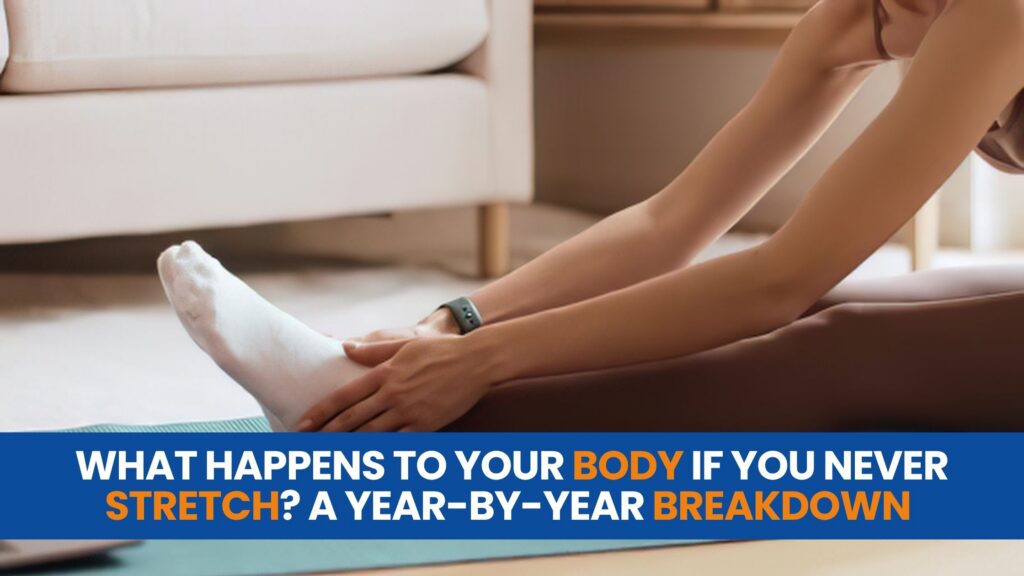
Skip stretching long enough and your body adapts to less movement. Joints lose range, muscle stiffness sets in, and poor posture becomes your new “normal.” The good news? Most of it is reversible with consistent, gentle movement – not a punishing routine.
1. You Usually Don’t Notice Mobility Loss All at Once
It happened last night. I dropped something in the kitchen. Right before I bent down to grab it, I paused – actually paused – to plan how I was going to bend over.
I am 61 years old.
Just the other day, I swear I was 40, wrestling around on that same floor with my son and not thinking twice about it. Then, somehow, this.
You stop stretching for a while. Nothing dramatic happens at first. Then one day it’s harder to reach your shoes, turn around to check your blind spot, get up off the floor, or stand up straight after sitting too long. Muscle stiffness and reduced mobility build gradually – a slow stack of small losses, not one big event.
I call this combination the four horsemen of stiffness: tight muscles, poor posture, reduced mobility, and a lifetime of moving less. None of them have to show up at your door.
2. First Few Months: Tightness Starts Showing Up More Often
In my younger years I was a ball of fire – running around all week, then doing yardwork the entire weekend. But once someone becomes less active and stops taking joints through their full range of motion, the body adapts by tightening up.
Here’s what that adaptation tends to look like: hips feel tighter after sitting, hamstrings lose some give, shoulders feel stiff by afternoon, and the back feels locked up in the morning. Movement, in general, just stops feeling smooth.
One important distinction: skipping stretches alone doesn’t “damage” your body. The bigger culprit is usually a combination of less movement, more sitting, and repeating the same limited postures day after day. Do you sit in the same chair every night? Is the TV always in the same spot? What about your car seat?
3. Around 1 Year: Your Comfortable Range of Motion May Shrink
Your body adapts to the movements it uses most. Stop raising your arms overhead regularly, and your shoulders eventually tighten around that smaller range. Rarely reach, rotate, squat, bend, or extend fully? Those movements start to feel foreign – even a little risky.
Over time you’ll notice a loss of flexibility, decreased range of motion, ongoing muscle stiffness, and more resistance during ordinary movement.
Think of it like a door you only ever open halfway. Eventually, halfway starts to feel like all the way. Or think about a cast on a broken bone – even six weeks in a cast leaves that limb feeling like a block of wood. Six weeks. That’s all it takes.
4. Years 2 to 3: Everyday Movement Patterns Can Begin to Change
Here’s a real test you can try right now. Sit up nice and tall. Raise both arms overhead and notice how high they go. Now slouch – really slouch, like a bored teenager – and raise your arms again.
Notice the difference? I’d bet you couldn’t lift them nearly as high the second time.
That’s the whole problem in miniature. People start bending from the back instead of the hips, taking shorter steps, avoiding deep squats, rotating the whole body instead of turning through the trunk, and reaching around stiffness instead of through it. Poor posture isn’t only caused by tight muscles – weakness, prolonged sitting, and habitual positions all play a part, too.
5. Years 3 to 5: Stiffness Can Start Affecting Activity Choices
You’ll hear it in the way people talk: “I don’t bend like I used to.” “Getting off the floor is harder than it should be.” “I stopped doing that because my knees feel tight.” “I just feel old.”
There’s a cycle hiding inside those sentences: less mobility leads to movement feeling harder, which leads to moving even less, which makes the stiffness more noticeable. Round and round it goes.
This shows up most in adults 50 and older, and it’s tied closely to overall joint mobility. It’s also completely avoidable – and, more importantly, reversible once you catch it.
6. 5+ Years: Mobility Can Begin Affecting Independence
Without being an alarmist about it, let’s look at the facts. Long-term drops in flexibility, strength, balance, and general activity can make everyday tasks genuinely harder: tying shoes, climbing into a low car, gardening, taking stairs, traveling, playing with grandchildren, or simply recovering after a stumble.
Here’s the part that matters most: stretching is only one piece of maintaining independence. Strength, balance, walking, and regular muscle stiffness management all belong in the same conversation about healthy aging.
7. What Happens to Posture If You Never Stretch?
Your grandmother was onto something – posture really does say a lot about a person. The question is what yours says about you.
Common postural adaptations from years of sitting include rounded shoulders, a forward head position, a stiff upper back, and hips that feel permanently tight. Good posture, by definition, is simply the position where your body spends the least energy standing upright. It’s efficient. But here’s the catch: any posture becomes bad if you hold it too long, because we’re built to move, not to freeze.
Movement itself promotes good posture correction – which is why my watch reminds me to stand up every hour. (It just buzzed, actually. Hang on.)

8. Muscle Stiffness Is Not Always Just a “Tight Muscle”
Time for a little science. In plain terms, muscle stiffness can come from inactivity, fatigue, stress, nervous system sensitivity, repetitive movement, reduced joint motion, weakness, or plain aging. It’s rarely just “a tight muscle” – that phrase oversimplifies something with several moving parts, and it’s why muscle tension relief usually needs more than one fix.
9. Can You Reverse Years of Stiffness?
There’s real hope here, and I mean that. Your body can regain meaningful mobility with steady, ongoing movement. My practical approach: stretch regularly, strength train, walk often, move joints through comfortable ranges, avoid sitting for hours without breaks, and work on balance. Stay consistent rather than stretching hard once a week and calling it done.
You absolutely can increase your flexibility as you age through consistent, gentle stretching – and the benefits compound the longer you stick with it. Stretching is a lot like brushing your teeth: good for you, and worth doing more than once.
10. Why Assisted Stretching Can Help
At our assisted stretching studios at StretchPlex in Delaware, people usually struggle with knowing what to stretch, reaching the right position, actually relaxing during the stretch, staying consistent, and knowing how much pressure feels right. A Body Coach guides the stretch while the client relaxes and moves through a comfortable range instead of fighting it alone.
Just two weeks ago, a client walked in saying she could no longer comfortably reach her shoes. After identifying tight hips, hamstrings, and limited trunk movement, her Body Coach built the stretching routine around the movements that actually mattered for her daily life.
11. Mobility Is Easier to Maintain Than Rebuild
I want to be clear: the goal is not to turn into a contortionist. It’s to keep enough mobility to keep doing the things you actually enjoy.
If stiffness has quietly become your “normal,” a $19 Intro Stretch at StretchPlex can show you exactly how your body moves and where you’re losing ground.
Locations: Hockessin · Greenville · North Wilmington
Frequently Asked Questions
Does not stretching actually cause muscle stiffness, or is something else going on?
Not stretching is part of it, but muscle stiffness usually comes from a bigger combination – less daily movement, prolonged sitting, and repeating the same limited postures. Inactivity, stress, and joint restriction all feed into it too. Assisted stretching targets the whole pattern, not just one tight spot.
Can poor posture really be fixed after years of sitting?
Yes. Poor posture develops slowly, and it can improve slowly too. Regular movement, targeted stretching, and strength work retrain the body to hold a more efficient position without forcing it. Most people notice a difference within a few consistent weeks – see our personal training options for a combined approach.
How long does it take to reverse muscle stiffness and regain flexibility?
There’s no universal timeline, but many people feel looser within two to four weeks of consistent stretching and movement. Full range-of-motion gains, especially after years of tightness, typically take a few months of steady work rather than one big session.
What’s the difference between stretching alone and assisted stretching?
Stretching alone is limited by how far you can safely push yourself and how well you can relax into a position. Assisted stretching uses a trained Body Coach to guide deeper, safer ranges of motion while you relax – which is often faster and more comfortable than solo stretching. Book a $19 Intro Stretch to see how it compares.