

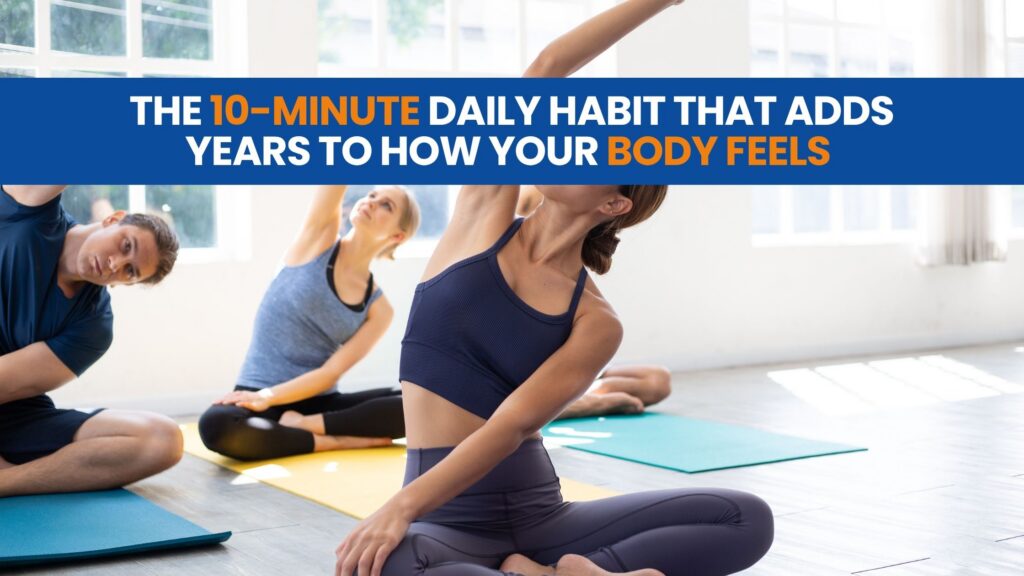
The habit is a 10-minute daily stretching routine – seven simple moves covering your neck, chest, upper back, hips, hamstrings, calves, and a sit-to-stand drill. Done consistently, it loosens the tightness that builds up from sitting, driving, and phone use, and helps you keep moving easily as you age.
You don’t wake up stiff one day. It creeps in.
First it’s the couch getting up feels like a small project. Then your neck catches a little when you check your blind spot while driving. Your hips feel tight after a long meeting. Your shoulders don’t reach as far as they used to. And one day, you make a sound just from standing up out of a chair.
I’ve watched this happen to clients slowly, over months, not overnight.
The good news is that small habits stack the same way stiffness does — just in reverse. A short daily flexibility routine built into your morning or evening can undo a lot of that tightness before it turns permanent.
I’m going to walk you through the 10-minute stretch routine I actually use myself.
You don’t need to become a gymnast. You don’t need an hour on the floor. You need to move your joints through a comfortable range often enough that your body remembers what it’s still capable of doing.
Ten minutes sounds small. Done daily, it adds up for how your body feels today, and for how it holds up years from now.
Consistency wins here. Not intensity.
Why Your Body Feels Stiffer Over Time
Age alone doesn’t explain stiffness.
Most of it comes down to how much you sit, how often you repeat the same movement, and how little variety your day actually has.
A typical day for most adults includes:
- Sitting at a desk
- Driving
- Looking down at a phone
- Watching TV
- Sleeping in one position
- Repeating the same workout or chores
Over time, some muscles stay short. Others barely fire at all. Hips tighten. Shoulders round forward. The upper back loses rotation. Calves and ankles stiffen up.
Even people who train a few times a week can still feel tight if they spend the rest of the day locked into one position.
A short daily routine focused on joint mobility interrupts that pattern before it sets in. One study found that marching in place for just 30 seconds every hour improved health markers in a measurable way proof that small, frequent muscle activation beats one long workout squeezed into a weekend.
Why 10 Minutes Is Enough to Matter
A 10-minute daily stretch won’t transform your body overnight. That’s not the point.
The real value comes from repetition.
Ten minutes a day adds up to more than an hour a week. Over a year, that’s 60-plus hours spent helping your joints and connective tissue move more freely. Not bad for something that fits before your coffee finishes brewing.
Short routines also feel doable. People quit health habits mostly because they overcomplicate them. A 45-minute plan sounds impressive on paper. It rarely survives a busy Tuesday.
But Ten minutes does.
You can fit it in:
- Before breakfast
- After a walk
- During a lunch break
- After work
- Before bed
The best time is whichever one you’ll actually repeat.
A Simple Full-Body Stretching Routine
A good routine targets the areas that get stiff from sitting and everyday life. Spend about a minute on each movement below.
- Gentle Neck Turns. Sit or stand tall. Slowly turn your head to one side, then the other. Keep your chin level and stay within a comfortable range. This helps with daily tasks like checking traffic or turning to talk to someone beside you.
- Chest Opener. Stand near a doorway and place one forearm against the frame. Gently rotate your body away until you feel a stretch across your chest and the front of your shoulder. Repeat on the other side. This one matters most if you work at a computer or spend hours on your phone.
- Upper-Back Rotation. Sit in a sturdy chair, feet flat. Cross your arms over your chest and rotate your upper body from side to side, slowly. This kind of thoracic mobility work matters for driving, golfing, reaching, and just about everything in between.
- Hip Flexor Stretch. Stand in a split stance, one foot forward, one back. Bend the front knee and shift your hips forward while staying upright. You’ll feel it near the front of your back hip. Tight hip flexors are almost universal among people who sit for long stretches of the day.
- Hamstring Stretch. Place one heel slightly in front of you. Keep that leg straight, not locked. Push your hips back gently until you feel a stretch behind the thigh. Don’t round your back or reach hard for your toes.
- Calf Stretch. Hands against a wall. Step one foot back and press the heel gently toward the floor. Ankle’s mobility supports walking, balance, and how your foot strikes the ground.
- Sit-to-Stand Practice. Sit near the front of a chair. Stand up slowly without using your hands. If it’s safe to do so, then sit back down with control. Not technically a stretch — but one of the most useful movements for maintaining strength and independence as you age. Repeat several times.
Stretching Should Feel Helpful, Not Punishing
A lot of people believe stretching has to hurt to work. It doesn’t.
You should feel gentle tension, not sharp pain, burning, numbness, or pinching. Bouncing or forcing a position usually backfires, causing the body to tighten instead of relax.
This is exactly why working with a stretch therapist can make such a difference. At StretchPlex, our trained assisted-stretching professionals are called Body Coaches, and they see where your movement is limited, adjusts your position, and controls exactly how much pressure gets used. That matters if you’ve had an injury, joint replacement, back problems, poor balance, or a fear of falling.
What a Professional Stretcher Can See That You Might Miss
It’s natural to stretch wherever you feel tight. But the spot that hurts isn’t always the spot causing the problem.
For example:
- Lower-back tightness often traces back to stiff hips
- Neck tension can connect to rounded shoulders
- Knee discomfort may come from limited ankle or hip movement
- A short walking stride often starts with tight calves or hip flexors
A professional stretcher looks at how your whole-body moves, not just the one area bothering you that day. At StretchPlex, clients often walk in saying they feel tight “everywhere.” Once we watch them move, we usually find two or three key areas driving most of the restriction.
One client came in because getting out of her car had become genuinely difficult. She expected us to focus on her lower back. Instead, we found her hips and upper legs were real bottlenecks. As those areas loosened through targeted assisted stretching sessions, standing and her first few steps got noticeably easier.
The goal was never to make her flexible like a gymnast. It was to help her feel steady and confident doing ordinary things.

Stretching for Healthy Aging
The biggest payoff from stretching probably isn’t touching your toes. It’s staying able to do the things you actually enjoy golf, gardening, travel, getting down on the floor with your grandkids, reaching into a cabinet, climbing in and out of a car.
Improving flexibility after 50 isn’t about chasing perfection. It’s about protecting your functional range of motion the movement patterns that keep you independent.
A regular 10-minute routine helps, especially paired with walking, strength training, balance work, and professional support when it’s needed. For anyone recovering from soreness or heavy training days, pairing stretching with muscle recovery tools can speed things along too.
Start Small and Stay Consistent
Don’t worry about building the “perfect” routine.
Pick a few movements that feel useful and repeat them daily. Notice how your body responds. Over time, you’ll likely stand taller, walk more easily, and feel less stiff after sitting.
Ten minutes won’t stop the clock. But it can help you feel more capable, more comfortable, and more confident as the years go by.
At StretchPlex, our team of trained stretch therapists and professional stretchers offers one-on-one assisted stretching built around your goals, comfort level, and movement needs. Curious what a session actually costs? Check our current pricing or book your first appointment to take a simple step toward feeling better in your body.
Frequently Asked Questions
How often should I do a 10-minute stretch routine?
Daily is ideal. Stiffness builds from repeated daily habits like sitting and driving, so undoing it works best with a daily counter-habit too. Even five days a week still makes a real difference over a few months.
Can stretching alone fix chronic tightness, or do I need extra help?
Self-stretching helps, but it usually targets the spot that feels tight not always the spot causing it. A trained specialist offering one-on-one assisted stretching can spot the real source, like stiff hips driving lower-back pain, and adjust pressure and range safely, especially if you have an injury history or balance concerns.
Is it normal for stretching to feel uncomfortable?
A gentle pulling sensation is normal. Sharp pain, burning, numbness, or pinching is not, and usually means you’re pushing too far or moving too fast. Slow down, or learn what a StretchPlex session involves if discomfort keeps showing up.
What’s the best time of day to stretch?
Whatever time you’ll actually stick with. Some people prefer stretching before breakfast to wake up the joints; others prefer after work to unwind from a day of sitting. Consistency matters far more than timing.