

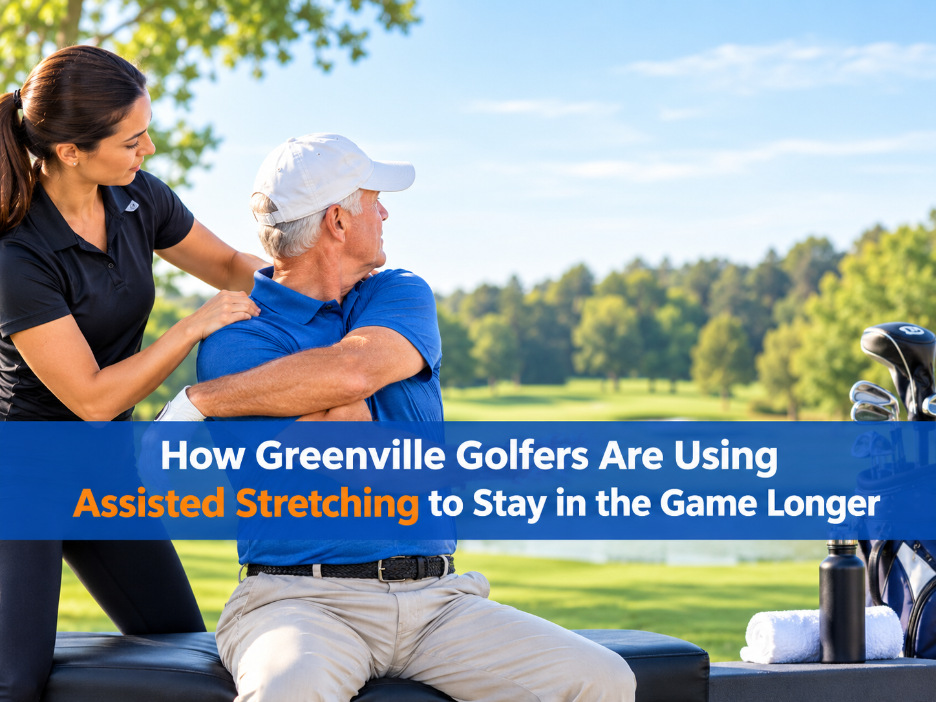
You stand over the ball, the same ball you’ve hit thousands of times, and something feels different. The back swing stops sooner than it used to. Your hips don’t turn the way they did. By the back nine, your lower back is already sending notes.
If that sounds familiar, you’re not losing your game. You’re losing range of motion, and that’s a very different problem. Senior golfer mobility is one of the most fixable parts of playing longer, and more golfers around Greenville are starting to treat it the way they treat their short game: something worth practicing on purpose. This post covers what actually changes in your body, how assisted stretching fits in, and how to work it into your season.
What Senior Golfer Mobility Really Means
Mobility is how freely your joints move through the range your swing needs. It’s not the same as raw flexibility, and it’s not the same as strength. You can be strong and still be stuck.
A golf swing asks a lot of a few specific areas:
- Hips: they rotate to start the downswing and let you transfer weight.
- Upper back (thoracic spine): it turns your shoulders behind the ball.
- Shoulders: they allow a full, comfortable arm path.
- Hamstrings and calves: they help you hold your posture over the ball.
- Ankles and feet: they give you a stable base to rotate against.
When one of these gets tight, your body borrows movement from somewhere else. Usually that’s the lower back or the lead shoulder, which is how a stiff hip turns into an achy round.
Why the Swing Gets Shorter with Age?
Tissues lose some of their give over time, and daily life adds to it. Long hours sitting, less overall activity, and old injuries all narrow the range your joints will comfortably travel. Golf then asks for a big, fast rotation on top of that.
The result is predictable. The back swing shortens, the follow-through gets cut off, and distance drops. Many golfers respond by swinging harder, which tends to make things worse, not better.
We look at this from the angle of both golf and tennis in our pillar guide on golf and tennis swing mobility in Greenville. Here, we’ll focus on what you can do about it.
What Assisted Stretching is (and why it’s different from stretching alone)
When you stretch on your own, you stop where it starts to feel uncomfortable or where your own effort runs out. You also tend to stretch what’s easy to reach, not necessarily what’s actually tight.
Assisted stretching means a trained practitioner guides your body through stretches while you relax. Because you’re not holding the position yourself, muscles can let go more fully. The practitioner can also work through areas you can’t easily reach or position on your own and adjust as they feel your body responds.
If you’re new to the idea, our page on what StretchPlex is explains the approach in more detail.
How assisted Stretching Helps a Golfer’s Body?
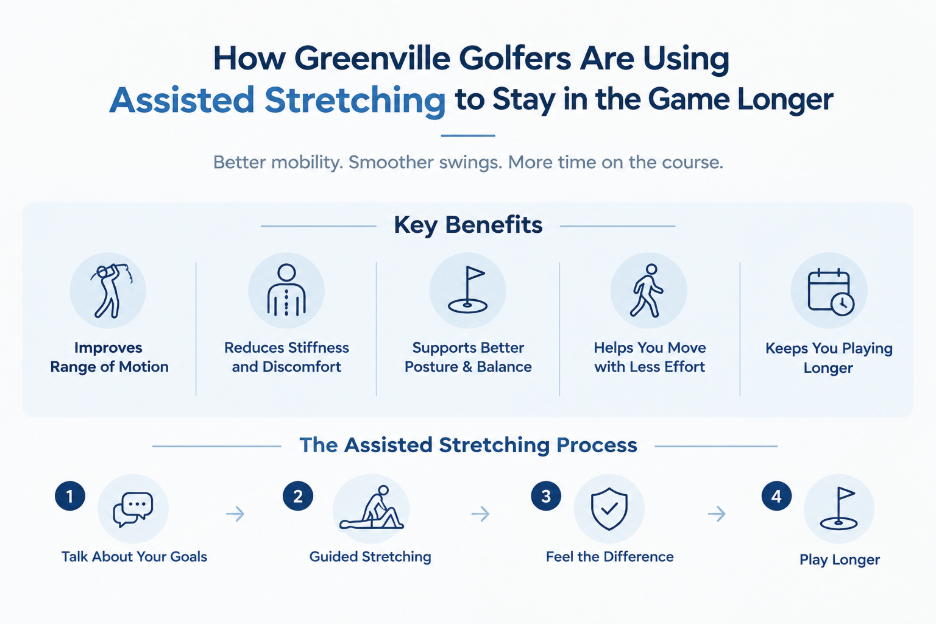
No stretching session will rebuild a swing. What it can do is give your body more room to move so your swing has more to work with. For golfers, the focus usually lands in a few places.
- Hips and glutes
Free-moving hips are the engine of rotation. Stretching the hip flexors, glutes, and the deep rotators can make it easier to turn and to shift weight without forcing it through your back.
- Upper back and shoulders
A stiff upper back limits how far your shoulders can turn behind the ball. Opening up the chest, mid-back, and shoulder joints supports a fuller turn and a smoother arm path.
- Hamstrings and lower back
Tight hamstrings can pull on your posture at your address and keep you from hinging comfortably. Easing them can take some load off the lower back, which is often the first thing to complain after 18 holes.
- Ankles, calves, and feet
This one gets overlooked. If you walk the course, your calves and feet do plenty of work, and a stable base makes rotation feel more natural.
What a Session can Look Like for a Golfer
Every person is different, so a good session starts with a conversation. You’d talk through how your swing feels, where you get tight, any injuries, and what you want from your game. From there, the work is built around you, which is the idea behind personalized stretching programs.
You can browse everything we offer on ourservices page or check pricing for StretchPlex if you’re comparing options.
Fitting it into your Golf Season
There’s no single schedule that suits everyone, but a simple way to think about the season helps:
- Before the season starts: build range of motion gradually, so you’re not asking a stiff body to turn full speed on opening day.
- During the season: use stretching to keep up the range you’ve gained and to loosen up between rounds.
- After long stretches of play: give tired hips, back, and legs a chance to reset.
- In the off-season: keep moving so you don’t start from zero every spring.
Your practitioner can help you decide how often makes sense based on your body and how much you play.
Pair Mobility with Strength and Recovery
Mobility works best when you also have the strength to control it. A hip that moves further but can’t stabilize won’t help your swing for long. That’s why many older golfers combine stretching with strength and flexibility training or personal training for seniors, so the new range is usable on the course.
For the walk itself, leg recovery can matter as much as the swing. If your legs feel heavy after a round,compression therapy with the SportPump recovery system is another option worth looking at.
Not Just for Golfers
The same principles apply to anyone who relies on rotation and reach, including tennis players, who need hip turn, shoulder range, and quick, comfortable movement on the court. If you play both, or you’re a racquet-sport player reading this, the pillar guide on golf and tennis swing mobility covers both sports.
Signs it’s time to work on your mobility
You don’t need to wait for pain. Pay attention if you notice any of these:
- Your back swing or follow-through feels cut short.
- You can’t turn your hips or shoulders the way you used to.
- Your lower back is stiff or sore during or after a round.
- You feel tight getting out of the cart or bending to the tee.
- Your distance has dropped even though your technique hasn’t changed.
Stretching should feel like a good pull, not sharp pain. If you have a joint replacement, a recent injury, or a medical condition, check with your doctor before starting something new, and tell your practitioner about it so the session fits your needs.
The Takeaway
A shorter swing usually means a body that’s moving less, not a game that’s finished. Improving senior golfer mobility gives your swing more room, your back an easier time, and your rounds more years. If you’re a Greenville golfer curious about where to begin, start with a conversation about how you move now.
FAQ
1. Is assisted stretching appropriate for senior golfers?
Yes, if performed by a professional, who can take you to your limit based on your current health history. Discuss your health and specific concerns with the practitioner, who will tailor the program based on your condition.
2. Will assisted stretching add distance to my drive?
No one can promise yardage. What it can do is improve how freely your hips, upper back, and shoulders move, which gives your swing more range to work with.
3. What’s the difference between assisted stretching, yoga, and stretching at home?
With assisted stretching, another person moves your body so that releases the muscles and stretches your body. At home and yoga stretching, it’s up to you to do all the work through your positioning.
4. How frequently should I stretch if I play frequently?
It varies from individual to individual and depends on your time of play and ambitions. Your practitioner can advise you on a pace that works for your season.
5. So do I have to be flexible to begin?
Not at all. Your program is designed to accommodate you and will progress at your own personal flexibility levels.
6. Can tennis players use the same approach?
Of course. Swing on the court should include rotation, shoulder range, and hip mobility. Check out our golf/tennis swing mobility pillar guide, for each sport.