People want to practice stretching on a regular basis, but their results show they need improvement. People experience three typical problems, which include tight muscles and persistent pain, and they cannot achieve their desired results. Your problem stems from choosing the wrong method you used to achieve your current results.
Assisted stretch therapy enables your body to safely and effectively achieve its maximum potential through this method.
Why Your Body Resists Traditional Stretching
Your body needs to use different approaches for which stretching appears to be an easy task.
Your body uses its protective mechanism when you do not have assistance for stretching exercises. The brain commands your body to halt muscle activity when your muscles enter a danger zone because of excessive force.
People encounter this issue because they can achieve maximum flexibility without reaching their target.
Your body will prevent you from advancing beyond your current level of dedication.
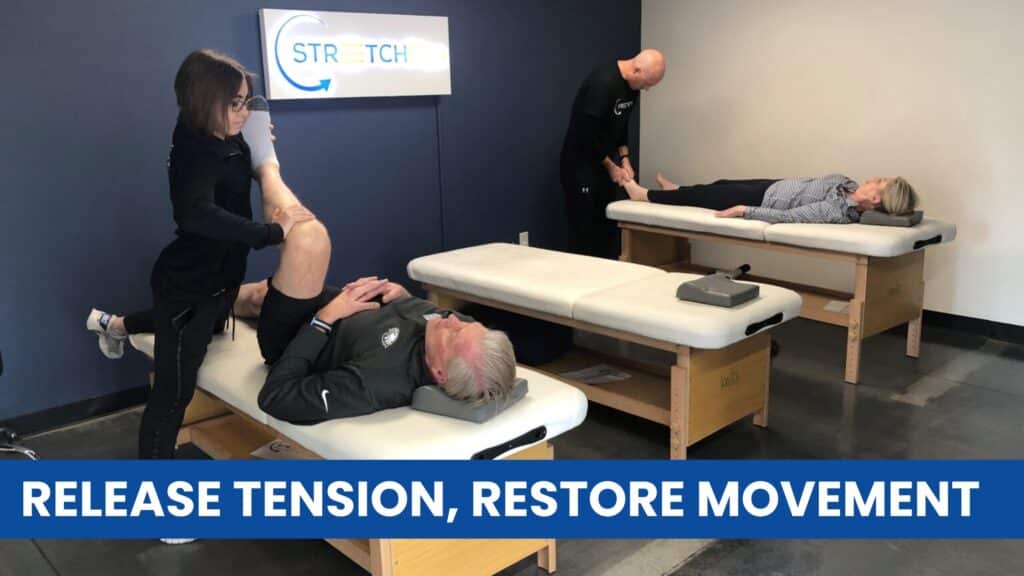
The medical team uses assisted stretching methods to manage your physical restrictions. The trained expert helps your body reach advanced stretching positions while your muscles stay in a relaxed state which enables muscles to develop throughout their range.
What Makes Assisted Stretch Therapy Different?
Your first impression of stretching leads you to believe that stretching consists of one simple activity.
The practice of assisted stretch therapy creates three vital components which people cannot achieve through self-stretching.
- External control
- Precise positioning
- Greater and safer range of motion
Assisted stretching uses the neuromuscular system to move your body into positions instead of using force.
The result creates an active stretch which produces superior stretching results.
The Science Behind Why It Works
The main concept of assisted stretching techniques involves retraining neuromuscular functions. You need to stretch your muscles because you must learn to control your body movement.
The PNF (proprioceptive neuromuscular facilitation) method functions through these three steps:
- The muscle is stretched.
- It contracts briefly.
- The muscle goes into a deeper stretch after relaxation.
The process enables your brain to recognize that your body can now stretch beyond its current limits. Your body develops its capacity to move after it adapts to existing conditions.
People achieve faster results through full body assisted stretching because it produces more dramatic outcomes than standard techniques.
What Happens When Your Body Releases Tension
People do not recognize their body holds tension until their body releases it.
Your body starts to release tension from:
- Deep muscle tightness
- Joint restrictions
- Accumulated stress patterns
The benefits become obvious through these:
- Movement feels lighter and smoother
- Flexibility improves steadily
- Pain and stiffness begin to reduce
- Posture naturally improves
The process of restoring body function includes both stretching and other activities.
Full Body Assisted Stretching: Why Everything Is Connected
Traditional routines often focus on one muscle group at a time.
The body functions as a unified system which controls all its essential functions.
Lower back pain occurs because of tight hips.
Restricted shoulder movement leads to posture problems and breathing difficulties.
Ankle joints that cannot move properly will affect both walking and balance functions.
The program uses full body assisted stretching to treat these connections.
The program uses full body training to enhance total body movement abilities and balance capabilities.
The Benefits Beyond Flexibility
The main result of assisted stretching techniques comes through better flexibility but these methods also deliver additional advantages because they provide deeper advantages:
Improved Movement Efficiency
Your body moves more smoothly and with better coordination, reducing unnecessary strain.
Faster Recovery
Improved circulation helps muscles recover more quickly after activity or long periods of inactivity.
Reduced Pain and Stiffness
Chronic tension in areas like the neck, back, and hips begins to ease.
Better Posture
As muscles rebalance, your body naturally aligns without constant effort.
Lower Risk of Injury
Improved mobility reduces the likelihood of strains and muscle injuries.
Why Stretching Alone Often Falls Short
People need to practice self-stretching with correct technique and regular practice and complete body awareness. Your body restricts your stretching ability to a maximum that you cannot surpass.
The therapy session reduces your treatment boundaries.
The program uses correct position guidance to help you achieve proper form while you get deeper results without causing extra strain.
The system stops multiple people from reaching their maximum capabilities because it eliminates all elements.
Who Can Benefit from Assisted Stretch Therapy
This treatment approach applies to both athletes and non-athletes.
In fact, many people who benefit the most are those with limited daily movement.
Assisted stretch therapy is especially useful for:
- Individuals with desk-based jobs
- People experiencing stiffness or limited mobility
- Fitness enthusiasts dealing with muscle tightness
- Those recovering from minor physical strain
The method helps people who experience body restrictions because it brings back their body equilibrium.

What the Experience Feels Like
People expect the process of assisted stretching to create strong pressure, but the actual experience creates a feeling of complete relaxation.
During full body assisted stretching, you are guided into positions while remaining relaxed.
The process enables:
- Deeper stretches without strain
- Immediate relief from tightness
- A noticeable improvement in movement afterward
The system combines stretching functions with therapeutic functions in a single treatment session.
Why This Approach Is Gaining Popularity
The body has become better understood which leads to improved recovery approaches and ongoing mobility development.
People are moving away from passive recovery methods and toward more targeted, guided techniques.
The modern wellness industry is seeing assisted stretching techniques become vital because they now create health improvement effects through their use.
The system focuses on delivering high-quality results which need precise work to reach their lasting effects.
The Core Reason It Works
The basic mechanism of assisted stretch therapy functions by decreasing resistance which exists inside the human body.
The body permits enhanced movement when muscles are at rest and the nervous system detects no danger.
This is when:
- Flexibility improves
- Pain decreases
- Movement becomes more natural
The process occurs through controlled guidance instead of requiring forceful execution.
Conclusion: A More Effective Way to Improve Movement
The problem which prevents your expected results from stretching may not stem from your stretching efforts. Your current method of stretching needs adjustment to achieve better results.
With assisted stretch therapy and advanced assisted stretching techniques and full body assisted stretching, you are not just stretching, you are improving how your body moves and functions.
The approach centers on three elements which include accurate execution and continuous system supervision and maximum time value.
People achieve better body results when they choose to support their body functions instead of trying to eliminate their natural body operations.
FAQs
1. What isassistedstretch therapy?
Assisted stretch therapy is a guided stretching method where a trained professional helps move your body into deeper stretches, improving flexibility and mobility more effectively than stretching alone.
2. How areassistedstretching techniques different from regular stretching?
Assisted stretching techniques use controlled guidance and precise positioning to help muscles relax and extend further, allowing better results without strain or incorrect form.
3. What are the benefits of full bodyassistedstretching?
Full body assisted stretching improves overall flexibility, reduces muscle tension, enhances posture, speeds up recovery, and helps prevent injuries by addressing the entire body.
4. How often should I doassistedstretch therapy?
For best results, assisted stretch therapy can be done 1–2 times per week, depending on your activity level, flexibility goals, and muscle condition.