
You’ve probably searched for leg stretching videos at some point. Maybe you’re dealing with tight hamstrings that never loosen up, hip stiffness after a long day at a desk, or calf cramps that show up on a walk around the block. I get it – I search for exercise videos too.
But here’s the thing. Watching a video doesn’t mean you’re doing it right.
At StretchPlex, we hear this constantly. Clients walk in after months – sometimes years – of self-stretching with zero improvement in their lower body mobility or range of motion. Their hamstring flexibility hasn’t budged. Their hips are still locked up. And they’re frustrated, because they have been doing the work.
Most of the time, the problem isn’t effort. It’s a technique.
These are the biggest mistakes we see, and what to do instead.
1. Rushing the Movement
Speed kills a stretch. That’s not a figure of speech – it’s a neuromuscular fact.
When you bounce into a position or yank yourself aggressively toward the floor, your muscles fire back. The stretch reflex kicks in. Your nervous system reads “threat” and tightens the very tissue you’re trying to lengthen. This is the opposite of what you want.
Think of it like a cold rubber band. Yank it and it snaps. Pull it slowly and it gives.
For any stretching exercise targeting the legs – hamstrings, hip flexors, calves, posterior chain – ease into the position deliberately. Let your nervous system catch up. If you’re moving so slowly it looks like you’ve stopped? You’re probably doing it at the right pace. That’s not a joke.
2. Holding Your Breath (and Not Realizing It)
This one’s sneaky. Most people don’t even know they’re doing it.
The moment a stretch gets uncomfortable, people instinctively brace. They clench their jaw, tighten their core, and stop breathing. And that muscle tension they just created? It fights the stretch directly.
Breath controls the nervous system. Long exhales signal the body to downregulate – to soften, release, and let connective tissue lengthen. Short held breaths do the opposite.
What actually works:
- Inhale slowly through your nose
- Exhale through your mouth, long and controlled
- Let your body drop a little further with each breath out
You can even whisper quietly to yourself during the stretch. Sounds odd. Works every time – because talking requires continuous airflow, which prevents breath-holding without you even thinking about it.
3. Only Stretching When You’re Already in Pain
Flexibility doesn’t work like a broken pipe you fix when it bursts. It’s more like brushing your teeth – small, consistent effort over time beats occasional marathon sessions every single time.
Five to ten minutes of lower body mobility work, three or four times a week, will do more for your hamstring flexibility and hip range of motion than a ninety-minute stretch session once a month. The tissue responds to repeated, gentle exposure. Not to occasional punishment.
Build it into your day. Morning. Lunch break. Before bed. Pick a trigger and attach it to something you already do.
Want to see how StretchPlex structures ongoing mobility sessions? Check out our program basics here.
4. Ignoring the Hips Completely
This is the one that catches almost everyone off guard.
If your hamstrings have been tight for years despite consistent stretching, there’s a good chance tight hip flexors are the real culprit. The hip flexor group – particularly the iliopsoas – pulls on your pelvis, which tilts your pelvis forward, which puts your hamstrings in a chronic shortened position before you even stand up. Stretching your hamstrings in that context is like trying to bail out a boat with a cup while the faucet’s still running.
Sitting worsens this fast. If you’re at a desk six to eight hours a day, your hip flexors are almost certainly shortened.
A proper lower body mobility routine covers all of this:
| Muscle Group | Why It Matters |
| Hip flexors | Pelvic tilt, lumbar compensation, hamstring restriction |
| Glutes / piriformis | Hip external rotation, sciatic nerve pressure |
| Hamstrings | Posterior chain mobility, knee and low back load |
| Quadriceps | Reciprocal inhibition – tight quads suppress glute activation |
| Calves / Achilles | Ankle dorsiflexion, gait mechanics |
| Inner thighs (adductors) | Hip abduction range, groin pulls |
| Lower back | Lumbar decompression, sacroiliac joint mobility |
Everything connects. Pull one thread and the whole chain shifts.
Curious about our full assisted stretching service and how we address the whole lower body? It’s worth a look.
5. Stretching Cold Muscles
Walking straight from your car into a standing toe-touch is a bad idea. Not the worst thing in the world – but definitely not getting you where you want to go.
Muscle tissue responds to blood flow. Warm tissue is more pliable, more receptive to length of change, and far less likely to send pain signals that make you back off before the stretch actually does anything. Cold muscles have less elasticity during this period.
You don’t need much. Five minutes is enough:
- Brisk walking in place
- A slow stationary bike ride
- Gentle bodyweight squats – 10 to 15, slow tempo
- Hip circles and leg swings
Think of it as preparing the tissue for work, not as a separate workout. Two minutes of dynamic warm-up movement dramatically changes how a static stretch feels and how much range of motion you actually get.
6. Mistaking Pain for Progress
A stretch should create tension. Not pain. Those are two different things.
Sharp pain, tingling, numbness, a burning sensation that runs down the leg – these are signals, not milestones. They mean something isn’t right: nerve involvement, overloading a joint, or a muscle pushed past its current capacity. Pushing through them doesn’t make you tougher. It triggers a protective muscular response that tightens the area even more.
The goal is a controlled, tolerable pull that you can breathe through and hold for 20-30 seconds. If you can’t breathe steadily while holding it, you’ve gone too far.
Back off slightly. Stay there. Let the neuromuscular system relax into it. That’s where actual length change happens – not at the pain edge.
7. Treating One Muscle Like an Island
Your body doesn’t work in isolated parts. It works in kinetic chains.
Someone with tight calves often has restricted ankle dorsiflexion. That restricted ankle changes how their knee tracks. That altered knee tracking shifts load to the hip. Tight hips pull on the lumbar spine. And now your “calf problem” has turned back stiffness. This isn’t rare – it’s the norm.
Focusing exclusively on one muscle while ignoring the rest of the posterior chain leads to disappointing results almost every time. The restriction you’re not addressing keeps pulling everything else back out of alignment.
This is exactly why we focus on full-body assisted stretching rather than isolated work. You treat the system, not just the symptoms.
8. Poor Body Position During the Stretch
A rounded spine during a seated hamstring stretch is one of the most common form mistakes we see. And it completely shifts the load off the hamstrings – where you want it – and dumps it into the lumbar spine, where you definitely don’t.
Small alignment adjustments change everything. Sitting tall with a neutral spine, slightly hinging at the hip rather than rounding forward, makes the same stretch dramatically more effective and far safer for the lower back.
The same applies to a standing quad stretch – if your pelvis tilts forward to compensate, the quadriceps never fully lengthen. One small posterior pelvic tilt before you pull your foot up? Total game changer.
Alignment isn’t about being rigid. It’s about directing the stretch where it’s supposed to go.
9. Trying to Do It All Solo
Self-stretching works. But it has a ceiling.
Here’s the mechanical problem: when you stretch yourself, your muscles stay partially activated because they’re doing the work of pulling you into position. They can’t fully relax at the same time. That partial activation limits how far the tissue can safely lengthen – and it means you’re never quite getting to the end range where real mobility gains happen.
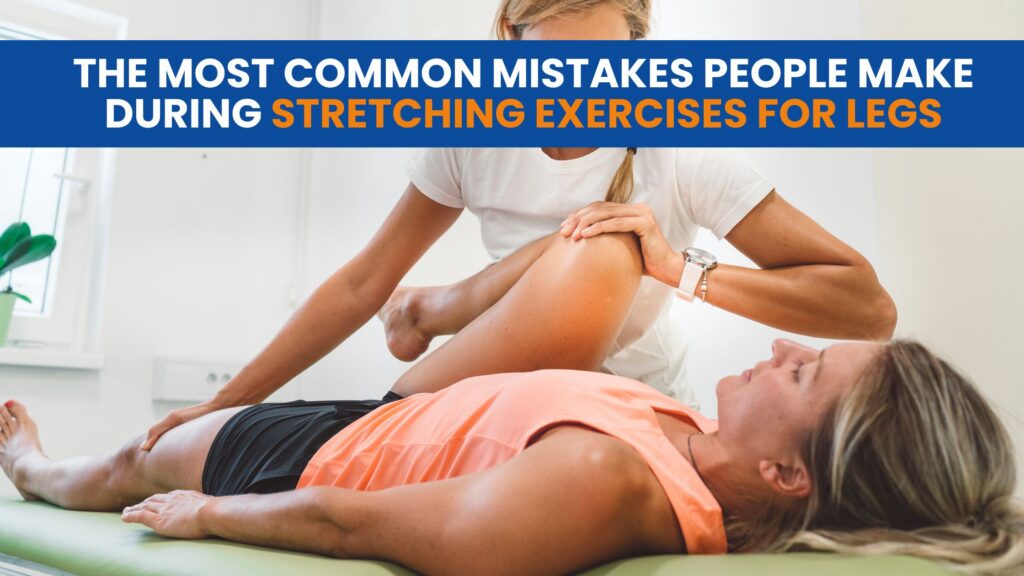
That’s the core advantage of assisted stretching at StretchPlex. Our Body Coaches move your body through the stretch while you stay completely passive on the table. No clothing change, no oil, no massage-table setup – you stay fully dressed and it fits easily into a lunch break or before a workout.
Because the muscles aren’t working against themselves, clients regularly achieve greater joint mobility in a single session than they’ve managed alone in months. And the changes tend to hold longer, because the nervous system was actually allowed to let go.
Want to see what sessions look like and what’s included? View our program basics or book directly here.

A Real-World Example From Our Table
One client came in convinced his hamstrings were the issue. He’d been stretching them every morning for six months. Zero improvement. He was getting close to giving up.
During his assessment, it became obvious: his hip flexors and quads were locked up so tightly that his pelvis was stuck in anterior tilt. Every hamstring stretch he’d been doing was pulling against a structural restriction he didn’t even know was there.
After several sessions targeting his full lower body – hip flexors, quads, glutes, and then hamstrings – he could bend forward comfortably for the first time in years. He also stopped walking stiff after long stretches at his desk.
The effort was never the problem. The target was.
The Fix Isn’t More Stretching. It’s Better Stretching.
If you’ve been frustrated with your flexibility, don’t assume your body “just doesn’t stretch.” That’s almost never the case.
Slow down. Breathe properly. Warm up first. Fix your alignment. Work the full lower body – hip flexors, glutes, hamstrings, quads, calves, inner thighs, and lower back – not just the part that hurts. And if you’ve hit a wall doing it solo, professional assisted stretching can move things faster than you’d expect.
Your legs carry you through every single day. Taking care of them is one of the smartest investments in your long-term musculoskeletal health and independence you can make.
Frequently Asked Questions
Q1: How long should I hold each leg stretch for real flexibility gains?
Most research on static stretching points to 20-30 seconds as the sweet spot for a single hold. Shorter than that, and the nervous system hasn’t had enough time to relax the muscle; longer than 60 seconds per hold offers diminishing returns for most people. More valuable than hold time is consistency – stretching four to five times per week will do more for your hamstring flexibility and overall lower body range of motion than occasional long sessions. If you’re working with a Body Coach at StretchPlex, assisted holds can safely go slightly longer because your muscles aren’t fighting the position.
Q2: Why do my hamstrings feel tight even though I stretch them every day?
This is one of the most common complaints we hear. Daily hamstring stretching with zero improvement almost always signals that the restriction is coming from somewhere else – usually tight hip flexors or an anteriorly tilted pelvis caused by prolonged sitting. When your pelvis is pulled forward, your hamstrings are already in a lengthened-but-tensioned position just standing still. Stretching them more doesn’t fix the root problem. Addressing hip flexor tightness, improving pelvic alignment, and working on the full posterior chain almost always breaks the plateau.
Q3: Is it better to stretch before or after exercise?
Both have value, but they serve different purposes. Dynamic stretching – leg swings, hip circles, slow bodyweight squats – works well before exercise because it increases blood flow to the muscles and primes your neuromuscular system without reducing force production. Static stretching (holding a position for 20-30 seconds) is better suited after exercise, when the tissue is warm, and the nervous system is already downregulated. Stretching cold, tight muscles before warming up first is a common mistake that limits how much the tissue actually responds.
Q4: What’s the difference between assisted stretching and regular massage?
They target different things. Massage focuses primarily on the soft tissue itself – blood flow, myofascial release, reducing muscle soreness (DOMS), and relaxation. Assisted stretching, like what we do at StretchPlex, targets joint mobility and muscle length by moving the body through specific ranges of motion while the client stays completely passive. Because you’re not activating the muscles to hold the position, the tissue can lengthen further than it typically can during self-stretching. There’s also no need to undress or use oils, which makes it easy to fit into a workday. If you’re curious, see our services page or claim a free demo session.