

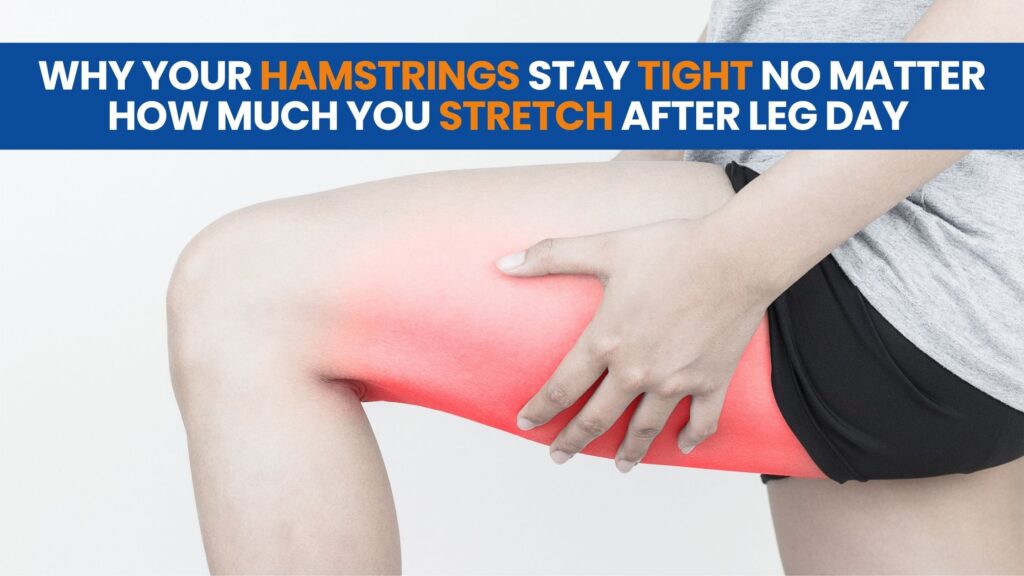
Your hamstrings stay tight after leg day because the tightness is often your body protecting itself, not a lack of length. Hard training causes small muscle tears and swelling. Your nervous system then tightens the muscles to guard it. Hips that don’t move well make it worse. Solo stretching rarely fixes this. Guided, assisted work on the hips and legs together usually does.
You crushed your leg day. Squats, lunges, deadlifts, the works. Now your hamstrings feel like steel cables. You stretch every night, yet the tightness comes back by morning.
Sound familiar? You are not doing it wrong. You are just treating the wrong problem. Let’s look at what is really going on, and what to do about it.
What “Tight” Really Means
Most lifters think a tight hamstring is a short hamstring. That is not always true. Often the muscle is normal in length. It just feels tight because your brain has turned up the tension.
Think of it like a car alarm that is too sensitive. Nothing is broken. The system is just on high alert. After a heavy session, your body treats the muscle as a threat and clamps down to protect it.
This is one reason a quick toe touch does so little. You are pulling on a muscle that is holding on for a reason. If you want a full picture of how guided stretching works, our assisted stretching page breaks it down.
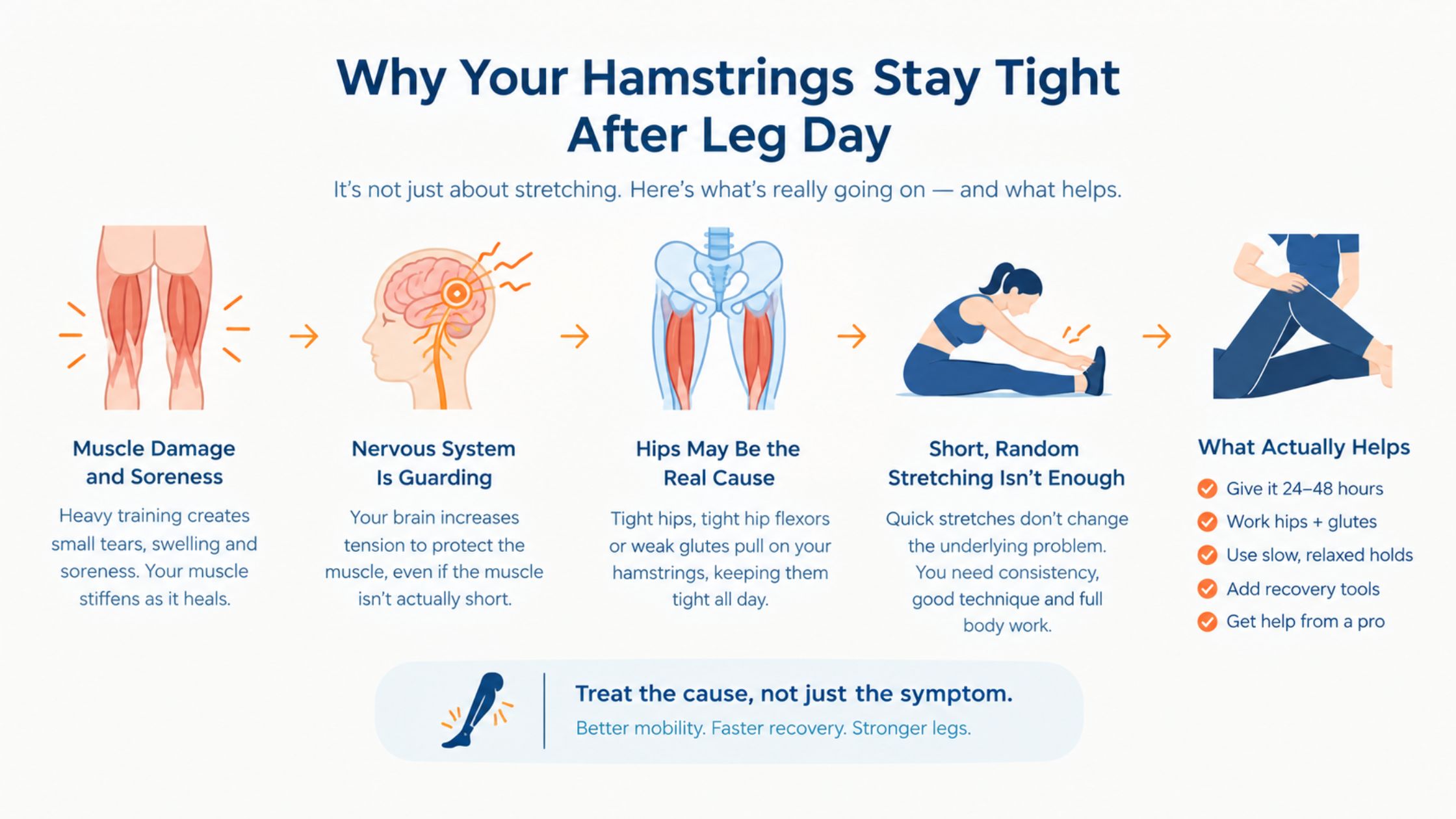
Reason 1: Muscle Damage and Soreness
Leg day creates tiny tears in muscle fibers. This is normal and it is how you get stronger. But it also brings swelling and soreness that peaks a day or two later.
Your hamstrings take a lot of this load, especially on deadlifts, split squats, and Romanian deadlifts. The muscle stiffens as it heals. Stretching hard on a sore muscle can feel bad and may even add to the irritation.
Lifters who want faster post-workout recovery in North Wilmington often start with a plan built around this healing window. You can see what that looks like on our North Wilmington location page.
Reason 2: Your Nervous System Is Guarding
Here is the part most people miss. Stretch tolerance is partly a brain thing. When a muscle is stressed, your nervous system limits how far it lets you go.
That is why you might stretch for ten minutes and feel a little better, only to feel stuck again later. You gained a bit of comfort, but you did not change the signal your brain is sending. A calm, slow, supported stretch helps the body relax and lets that signal ease off.
This is where a trained partner makes a real difference. When someone else moves your leg, you can let go completely. That is hard to do on your own. Our program basics page explains how a session is structured.
Reason 3: The Problem May Start at Your Hips
This one surprises people. Your hamstrings attach to your pelvis. If your hips are stiff or your pelvis tilts forward, the hamstrings get pulled tight all day long. They are working overtime just to hold you upright.
Tight hip flexors from sitting can do this. So can weak glutes. In both cases, the hamstring is the victim, not the cause. You can stretch it forever, and the pull from the hips will keep winning.
This is exactly why hip work matters so much. We go deeper on this in our guide, Foam Rolling vs. Assisted Stretching: Why One Actually Reaches Your Hips. It shows why a roller alone often misses deeper hip tissue.
Reason 4: Short, Random Stretching
Holding a stretch for 20 seconds after your workout is better than nothing. But it is often too short and too rushed to change much. Your muscles are still warm and worked, and your body is still on guard.
Consistency and technique count more than effort. A gentle, longer hold with good positioning beats a hard, bouncy pull every time. And stretching one muscle in isolation ignores the chain of muscles around it.
If you are training hard and want a smarter plan, our personal training team can help you balance strength work with mobility.
What Actually Helps Tight Hamstrings
The good news is that this is fixable. Here is a simple approach that works for most lifters.
Give it 24 to 48 hours. Right after a brutal session, go easy. Light walking and gentle movement help more than deep stretching on day one.
Work the hips, not just the hamstrings. Add hip flexor and glute mobility to your routine. This takes the constant pull off the back of your legs.
Use slow, relaxed holds. Breathe out and let the muscles soften. Forcing it only makes the guarding worse.
Add recovery tools. Tools like percussion therapy can help calm tight tissue and compression therapy can help your legs feel fresher between sessions.
Get help from a pro. A trained stretch therapist can move you through ranges you can’t reach alone. That is the biggest jump most people feel.
Are You Missing a Key Piece of Recovery?
Many serious lifters lift hard, eat well, and sleep enough. Yet their recovery has a gap. They skip structured mobility work and hope a few stretches will cover it.
That gap is often why tightness never leaves. If this sounds like you, read The Recovery Routine Serious Lifters in North Wilmington Are Missing. It lays out a simple routine you can start this week.
How StretchPlex Can Help
At StretchPlex, we focus on assisted stretching, mobility, and recovery. A trained practitioner guides your body through each stretch, so you can fully relax and get deeper, safer results. Learn more about what StretchPlex is and how we work.
If you want to feel the difference, you can claim a free stretching demo. When you are ready to go further, check the pricing options or book your session today.
Tight hamstrings do not have to be your normal. Once you treat the cause and not just the symptom, your legs can feel loose, strong, and ready for the next session.
Frequently Asked Questions
Why are my hamstrings so tight after leg day?
Heavy training causes small muscle tears, swelling, and soreness. Your nervous system also tightens the muscles to protect it. Stiff hips can add more pull on the hamstrings, which keeps them feeling tight.
Should I stretch my hamstrings after leg day?
Yes, but keep it gentle. Right after a hard session, use light, slow stretches, and easy movement. Save deeper stretching for when soreness has eased, usually 24 to 48 hours later.
How long do tight hamstrings take to recover after a workout?
Most soreness fades within two to four days. Tightness that lasts longer may point to poor hip mobility, weak glutes, or not enough recovery work. If pain is sharp or does not improve, see a medical professional.
Does assisted stretching help tight hamstrings?
It can. With assisted stretching, a trained practitioner supports your leg so your muscles can fully relax. This makes it easier to reach the hips and legs together, which is often the missing piece.