


Why Are My Hips So Tight? The Usual Suspects
It’s rarely one thing. For most tennis players, it’s a mix of these:
- Too much sitting. Hours at a desk keep your hip flexors short. Then you stand up and sprint for a drop shot, and those muscles haven’t had a chance to lengthen.
- One-sided repetition. Tennis isn’t symmetrical. You serve, rotate, and push off the same way thousands of times, so one hip usually ends up tighter than the other.
- Glutes that aren’t pulling their weight. When the glutes under-work, the muscles around them pick up the slack and feel tight. Sometimes that tightness is your body protecting a weak spot, not a true lack of length.
- Skipped recovery. Hard sessions with no cooldown leave muscles stiff, especially across back-to-back match days.
One thing to keep straight: tight isn’t the same as painful. Sharp pinching in the hip, pain that hangs around after you play, or numbness down the leg means it’s time to see a licensed clinician, not to stretch harder.
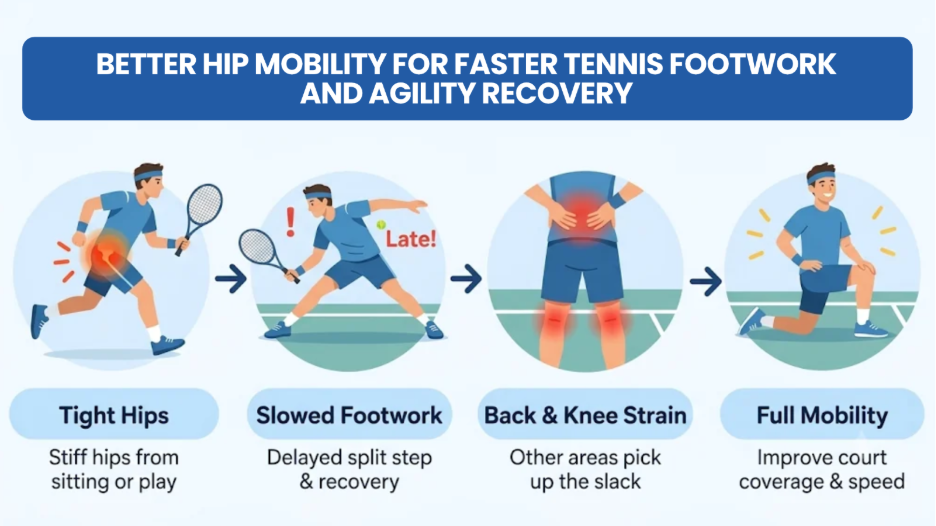
How Tight Hips Hurt Your Footwork and Agility
Your hips are the hinge for almost everything you do on court.
- The split step. A good one needs you to load and drop into a balanced stance. Stiff hips make that landing shallower and slower.
- Lateral movement. Shuffling and crossover steps depend on hip rotation and abduction. Restriction shortens your stride and costs you court coverage.
- Open-stance forehands. Rotating through the shot requires the hip to turn freely. When it can’t, the low back and knee often pick up the slack.
- Recovery. Pushing back to the center after a wide shot is where tight hips show up most. You arrive a half-step late, and that half-step is the point.
Better mobility won’t turn you into a different athlete overnight. What it does is give your legs and trunk more room to do the things you already train them to do.
A Two-Minute Hip Self-Check
Before you stretch, find out where you’re limited. Move gently and stop if anything hurts.
- Deep squat hold. Can you sit into a squat with heels down and chest up? Heels lifting or knees caving can point to restricted hips or ankles.
- 90/90 seat. Sit with one leg bent in front and the other bent behind you. If getting upright is a struggle, rotation is probably limited.
- Half-kneeling check. Kneel on one knee and tuck your pelvis. If you feel a strong pull at the front of the back hip, that’s your hip flexor.
Compare left and right. A big difference between sides is useful information.
Five Mobility Stretches to Start With
Spend about 8 to 10 minutes on these after a warm-up or a light walk. Avoid forcing positions, and breathe slowly.
- Half-kneeling hip flexor stretch: Tuck your pelvis under, squeeze the glute of the back leg, and shift forward slightly. Hold 30 to 45 seconds per side.
- 90/90 hip switches: Rotate from one 90/90 position to the other, keeping your torso tall. Do 8 to 10 slow reps.
- Figure-four stretch: Lying on your back, cross one ankle over the opposite knee and draw the legs toward you. Hold 30 to 45 seconds per side.
- Adductor rock-back: From hands and knees, extend one leg out to the side and rock your hips back. Do 8 to 10 reps per side.
- Deep squat with a pause: Sit into a squat, press the knees gently outward with your elbows, and hold for 30 seconds.
- Short and steady wins here. Four brief sessions a week usually beat one punishing session on Sunday.
When Self-Stretching Isn’t Enough: Mobility Stretches Greenville Players Can Add
Some hips stay stubborn no matter how many 90/90 switches you do. That’s usually the point where outside help makes sense, since it’s tough to fully relax a muscle while also holding yourself in the stretch.
- Assisted stretching. A practitioner moves your leg through its range while you stay relaxed, which gets you into positions that are hard to reach alone. It’s especially useful when one hip is clearly tighter than the other.
- Compression therapy. After a heavy match week,compression therapy can support leg recovery so you feel fresher for the next session.
- Strength and movement coaching. The new range only sticks if you can control it.Personal training builds the glute and core strength that stops your hips from tightening up as a defense.
- Not sure where to start? BrowseStretchPlex’s services and see what fits your schedule and your game.
Build It Around Your Tennis Schedule
A simple weekly rhythm works for most recreational and club players:
- Before play: 5 minutes of dynamic leg swings and bodyweight squats.
- After play: The stretches above while your muscles are warm.
- Rest days: One longer mobility session, or a professional visit if you have access to one.
Pay attention to how your split step and recovery steps feel, not just how bendy you look in a stretch. Footwork that feels quicker is the real test.
Final Takeaway
If you keep asking why my hips are so tight? the answer is usually a mix of sitting, repetitive tennis movement, and under-working stabilizers. The fix is steady rather than dramatic: find where you’re limited, stretch consistently, build strength in your new range, and add hands-on help when you plateau. Start with the five stretches this week and notice how your first step off the baseline feels.
Ready to move better on court? VisitStretchPlex to book a session and see how full body stretching and recovery can fit your tennis routine. Still deciding where to go? Read our pillar guide tostretch places near Greenville for tennis players.
FAQ
- Why are my hips so tight even though I stretch?
Tightness can come from weak stabilizers, not just short muscles. Pair stretching with glute and core strength work, and check whether you’re holding stretches long enough to relax into them. - Can tight hips cause knee or low back pain in tennis?
They can contribute. When the hips can’t rotate or extend well, the knees and lower back often absorb extra load. Persistent pain should be checked by a clinician. - How long does it take to improve hip mobility?
It varies by person, but many players notice small changes in a few weeks of consistent work. Expect gradual progress rather than overnight change. - Should I stretch before or after tennis?
Use dynamic movement (leg swings, squats) before play and longer static holds afterward. - Is assisted stretching worth it for tennis players?
It can help if you hit a plateau or have a clear side-to-side difference, since a practitioner can guide you into ranges that are hard to reach alone.