


Golf and tennis swings can feel shorter with age and reduce mobility. Changes in strength and slower recovery are some of the factors that may play a role. This article explains how mobility affects both swings and covers three ways to work on it: assisted stretching to improve range of motion, compression therapy to support leg recovery, and strength training to help the gains last. It’s written for golfers and tennis players in Greenville, DE who want practical next steps.
Plenty of golfers and tennis players describe the same shift over the years. The backswing stops a little earlier. The follow-through feels tighter. A serve that used to feel easy now takes some reach.
There’s rarely one cause. Technique, equipment, old injuries, strength, and recovery can all play a part, and no article can tell you which ones apply to you. Mobility, meaning how freely your joints move, is one piece worth looking at. If you’re researching golf mobility in Greenville, DE, this guide covers how it can affect swing length in golf and tennis, and what can help.
How Mobility Changes Affect Your Swing?
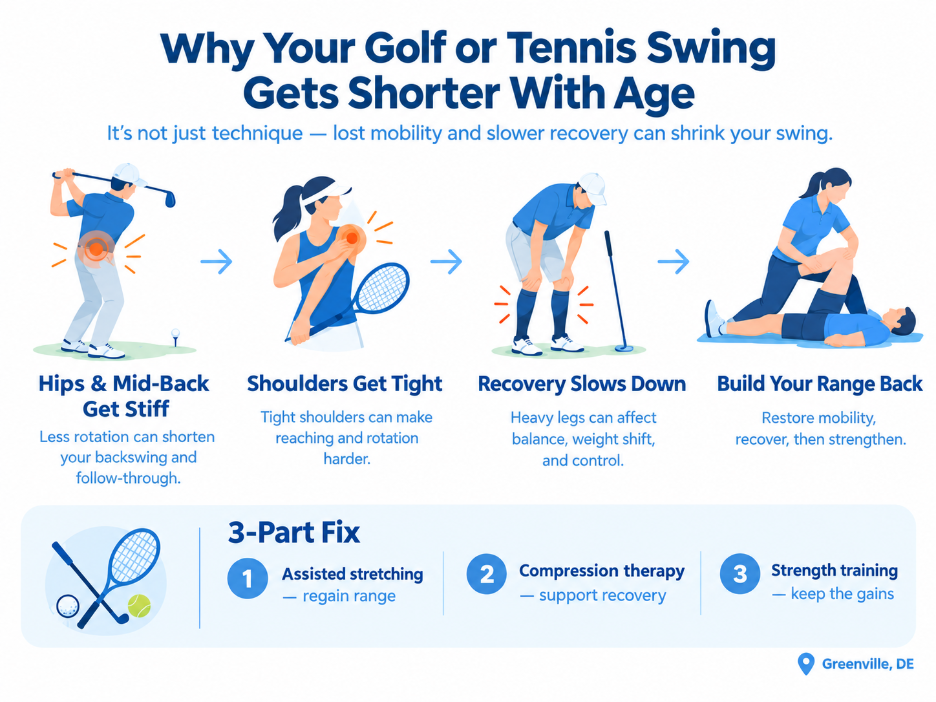
Think of a swing as a chain: ankles, hips, mid-back, shoulders, wrists. Each joint takes a turn. When one gets stiff, the next picks up the slack, and after a few years the whole motion can shrink without you ever deciding to swing shorter.
-
In Golf
Golf asks for a lot of rotation. The mid-back is meant to turn, but desk work and long hours behind the wheel can limit how far it goes. When it doesn’t rotate freely, the arms may end up doing more of the work. Tight hips can have a similar effect, since the lower back may absorb a twist, the hips couldn’t handle. That’s one reason some players feel sore after 18 holes.
-
In Tennis
Tennis adds overhead reach and quick bursts of movement. A serve depends on the shoulders and upper back moving freely, while forehands and backhands need the hips and trunk turning together. If any of those areas feel restricted, strokes can feel shorter or rushed, and it’s easy to start swatting with the arm instead of turning the body.
-
Recovery
Recovery matters in both sports. Play on Saturday, still feel it on Tuesday, and you start swinging a bit more carefully. A careful swing is often a shorter one.
First, Improve Range of Motion
Strength can come later. If a joint can’t comfortably get into a position, there’s not much to build on yet. Assisted stretching is one way to work on that. A practitioner guides your limbs through a comfortable range of motion while you stay relaxed, so you can reach positions that are hard to get into alone. For golf and tennis, the focus is often on the hips, upper back, hamstrings, and shoulders.
People sometimes call it a stretching massage, but the two aren’t the same thing. Massage mainly targets muscle tension. Assisted stretching is about how far a joint can move. Some people like to use both. Our assisted stretching page explains how it works at our Greenville location, and our stretching services page lists the other options.
Then, Support Leg Recovery
Eighteen holes is a long walk. A long tennis match can be just as tough, with constant starts, stops, and changes in direction. When your legs feel heavy, your stance and weight shift can change, and the swing may shorten to make up for it. Most people don’t notice it happening.
Compression therapy for legs is one option for some people to use to support recovery. Inflatable sleeves squeeze in waves from the feet upward. Plenty of athletes like it after long days because it leaves their legs feeling lighter. Results vary from person to person, so treat it as a recovery tool, not a cure.
We offer compression therapy with the SportPump recovery system at our Greenville location. If you have circulation problems, unexplained swelling, or a history of blood clots, talk to your doctor before trying it.
Build Strength to Support Mobility
This is the part people skip. Stretch a joint open without strengthening it and your body tends to drift back to where it started. You need muscle that can control the extra rotation, not just reach it.
For swing sports, that usually means the hips, glutes, core, and upper back. In golf, those muscles help create and control rotation. In tennis, they also keep you balanced through quick changes of direction and support the shoulder on serves and overheads.
Coming back from an injury? Or has something hurt every time you’ve pushed your swing? A personal trainer for injury recovery in Greenville can build a plan around what your body can handle today. That tends to beat the usual loop of rest, feel fine, overdo it, repeat. You can see how it works on ourpersonal training page.
A Simple Mobility and Strength Routine
Keep it small.
- Before you play: Spend five or ten minutes on easy movement. Golfers can try torso turns, leg swings, and shoulder rolls. Tennis players can add arm circles, side shuffles, and light overhead reaches. Save the long stretches for later, since cold muscles don’t love them.
- After you play: Do slow stretches for the hips, chest, and back while you’re still warm.
- Once or twice a week: Add strength work for the hips, glutes, core, and upper back. Glute bridges, split squats, rows, and light rotation exercises are common examples, and a trainer can adjust them to your body. Assisted stretching fits here too.
- After heavy days: Add a recovery session if your legs feel flat.
Short and regular beats one big effort every few weeks.
How Long Does It Take to See Progress?
It depends. Someone with a decade of stiffness and an old shoulder injury won’t move at the same pace as someone who’s just a bit tight. Some people feel looser within a few sessions. Others need weeks before the swing changes. If anyone promises a date, they’re guessing.
A better approach is to track a few things over time. How far can you rotate comfortably? How long can you play or practice before you feel tired or sore? How does your swing feel? Tennis players might also notice how the serve feels overhead and how they’re moving late in a match.
When to See a Doctor First
Sharp pain, numbness, a recent injury, or pain that gets worse as you swing? See a doctor before you start anything new. Stretching and training can help with a lot, but they don’t replace a diagnosis.
Explore Stretching and Training in Greenville, DE
Not ready to book? That’s fine. Read what StretchPlex is and look over the pricing so nothing surprises you. Then decide whether stretching, recovery, training, or a mix suits your game. A shorter swing doesn’t mean you’re done with the game. For many players, working on mobility, strength, and recovery is a good place to start.