
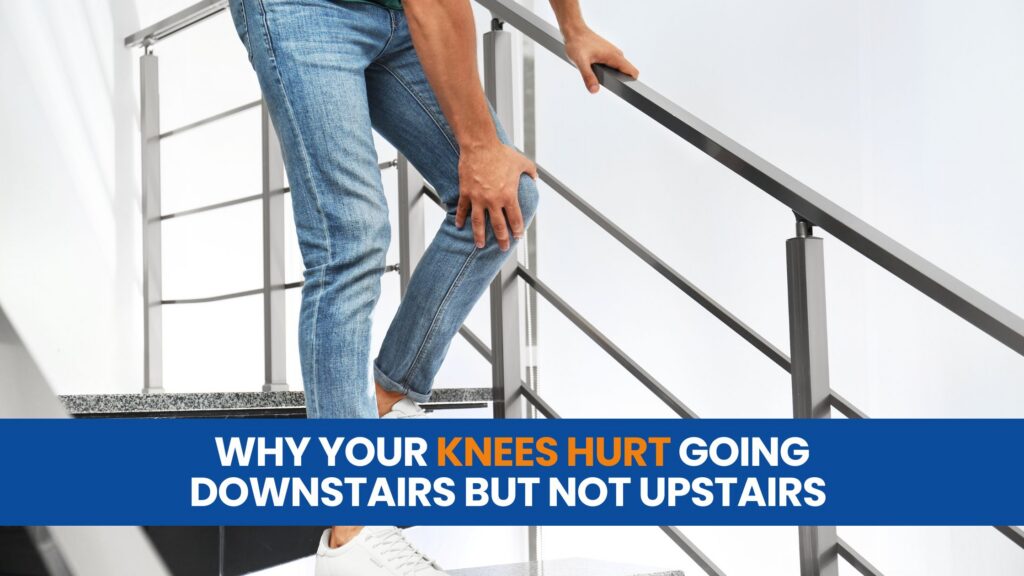
Going downstairs puts 3 to 5 times your body weight through your kneecap, while going up mostly uses your hips and glutes instead. That extra force under the kneecap is why your knee hurts on the way down but feels fine on the way up.
I hear this question a lot. Someone climbs four flights with no problem. Then they wince walking down one flight at home. It sounds backward. It isn’t.
Walking upstairs is easy on the knee. Your muscles shorten as they push. The work spreads across your hips, glutes, and hamstrings. Going down is different. Your quad muscles must stretch while they hold your weight. That’s harder on the joint. Doctors call it an eccentric contraction.
Here’s a number that surprises most people. Your kneecap can handle 3 to 5 times your body weight on the way downstairs. Going up, it’s closer to 2 to 3 times. A 160-pound person may push 700 to 800 pounds of force through that joint on a single flight down. This is exactly the kind of hidden strain our clients uncover during a first movement assessment, long before they ever mention their knees.
What’s Really Going On In There
Most people who feel pain on the way down have one of these issues:
- Patellofemoral pain syndrome. Some call it runner’s knee, even if you don’t run. Your kneecap slides slightly off track in its groove. Going downstairs is when that bad tracking hurts the most.
- Weak quad muscles. One small muscle on the inner thigh, the VMO, keeps your kneecap steady. If it’s weak, the kneecap drifts sideways under load.
- Early cartilage wear. The underside of your kneecap takes the brunt of the force. Mild wear stays quiet on flat ground. Stairs make it loud.
- Tight hips or IT band. Tight tissue pulls your kneecap off its normal path. You won’t feel it standing still. You’ll feel it going down.
None of these show up going upstairs. The muscles just don’t get loaded the same way. That’s the mystery solved. Now here’s what to do about it. A trained set of hands can usually spot which one of these is yours within a single assisted stretching session.
Why Strength Alone Won’t Always Fix It
I’ve trained people who could leg-press 300 pounds and still winced on stairs. Strength wasn’t the issue. Control was. A muscle can be strong in the middle of a movement and still fail at the end range, right where stair control happens.
This is where mobility work matters. A tight quad, a stiff ankle, or a hip that won’t fully extend forces your knee to compensate. And compensation under load is exactly how kneecap pain starts. Most people skip right past this step and buy a knee brace instead. Pairing loose tissue with structured strength coaching tends to get better, faster results than either one alone.

A Simple Plan That Actually Works
- Loosen the tissue pulling your kneecap off track. Quads, hip flexors, and the IT band are the usual suspects. Foam rolling helps a little. A trained hand doing focused stretch work helps a lot more. It reaches tissue youcan’t reach alone.
- Train the lowering motion, not just the lifting motion. Slow step-downs teach your quad the exact jobit’s failing at on stairs. Try three sets of eight. Count to four on the way down. Do this twice a week for six weeks. Most people notice a real change by then. A quick session with a deep tissue massage tool beforehand can loosen things up enough to make the reps feel smoother right away.
- Check your hip and ankle, not just your knee. The knee often takes the blame for a problem that starts elsewhere. A stiff ankle forces your knee forward and inward as you step down. Many people never realize their ankle is the real cause until someonechecks it. Little things like this get missed on your own, which is exactly why a second pair of trained eyes tends to catch what months of solo stretching won’t.
- Use recovery tools between sessions. A round with theSportPump recovery system after a hard leg day keeps swelling down and blood moving through tired muscle. It’s not a replacement for the stretch work, but it stops tight tissue from creeping back before your next visit. That gap between sessions is where most people quietly lose their progress without noticing.
- Combine stretching with real strength work. Want lasting relief, not just a quick fix? Loose tissue plus strong muscle is whatprotects your knee long term. Neither one does the job alone, and clients who only stretch tend to plateau within a few weeks. Adding structured resistance work on top of mobility is where the real, lasting change happens.
When You Should See a Doctor Instead
A mild ache that fades in a day usually just needs the plan above. But sharp pain, swelling, or a knee that buckles under you is different. So is pain that keeps getting worse over weeks. That’s a doctor visit, not a stretch session. Don’t guess your way past a torn meniscus. If nothing above sounds like your situation, please talk to a physician before starting any new exercise routine, and treat that advice as the priority over anything written here.
Your Next Step
If stairs have become something you plan around instead of just walking down, get it checked instead of guessing. Curious what this looks like week to week? We break down how our program works before you ever commit to anything, so there’s no guessing about what a first visit involves.
Most clients notice a real change in two to three weeks once we fix the actual cause. Usually it’s tight hips, a weak quad, or a stiff ankle. Not something rest alone will fix, and not something that improves on its own if you keep favouring that leg on every set of stairs you meet.
Budget is usually the next question people ask, and that’s fair. You can view our current pricing to see what a plan like this costs before you start, so there’s no surprise once you walk through the door.
Once you know the cost and the plan, the only thing left is picking a time. Ready to stop dreading the stairs? Book your first visit and find out what’s really pulling your kneecap off track.
FAQs
Why does my knee hurt more goingdownstairsthan climbing them?
Going downstairs uses your quad muscles in a way that puts 3 to 5 times your body weight through your kneecap. Going up only puts about 2 to 3 times your weight through it. That extra force is why the pain shows up on the way down.
Is knee pain on stairs a sign of arthritis?
Not always. It’s more often linked to weak quad muscles, a kneecap that tracks off centre, or tight hip tissue. Cartilage wear is possible too, but you’d need imaging and a doctor’s exam to confirm arthritis. Stair pain by itself isn’t proof of it.
Can stretching really help knee pain on stairs?
Yes, especially when tight quads, hip flexors, or IT band tissue are pulling your kneecap off track. Loosen that tissue and pair it with slow, controlled step-down exercises, and most people feel a real difference within weeks.
Should I avoid stairs completely if my knee hurts going down?
No, that usually makes things worse over time. Weak muscles get weaker with rest alone. Instead, go slower, use a rail, and take one step at a time while you fix the root cause behind the pain.